
Japan to launch world-first sample return from Martian moon
MMX spacecraft departs Tuesday on H3 rocket for five-year voyage, ten grams of soil to settle whether Phobos is captured asteroid or Mars impact debris
Images
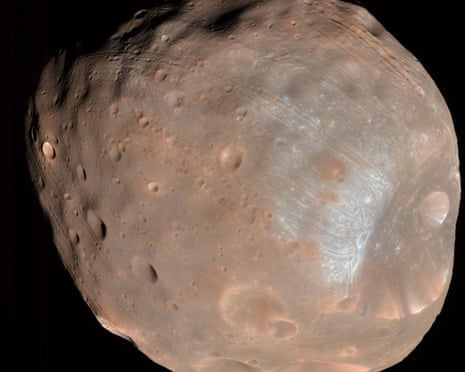 Phobos photographed by Nasa's Mars Reconnaissance Orbiter in 2008. Photograph: Nasa/AP
theguardian.com
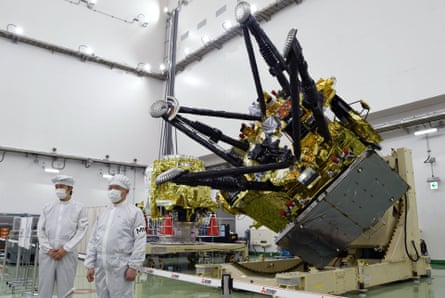 Jaxa unveiling the spacecraft for its martian moon mission at the Tanegashima Space Center in August. Photograph: Yuika Kawazoe/Kyodo News/AP
theguardian.com
 Japan to launch spacecraft on a mission to get samples from a Martian moon – WTOP News
wtop.com
Japan launches a spacecraft on Tuesday to do what no country has done: bring home samples from the moon of another planet. The target is Phobos, the larger of Mars's two small, potato-shaped companions, and the vehicle rides Japan's new mainstay H3 rocket on a mission expected to last five years.
The Martian Moons eXploration mission, run by the Japan Aerospace Exploration Agency, reaches the Mars region around August 2027, spends three years flying near and around Phobos, and returns in 2031. The craft weighs about five tonnes and splits into three modules — propulsion, exploration and return — and only the return module makes the trip home, with the soil sealed in a capsule. The direct distance to Mars is 55 million kilometres at closest approach; the actual flight path runs to 500-600 million.
Japan leads, but the manifest is international. Of the 13 instruments aboard, NASA supplies the sampling device and the European Space Agency a deep-space communications unit; a French-German rover named Idefix lands on Phobos first and spends about 100 days surveying the surface to guide the later digging, and a Japanese radiation monitor collects data for a possible crewed Mars mission. The United States and China are working toward sending astronauts to Mars — while project manager Yasuhiro Kawakatsu notes that the moons those crews would depend on 'have never been fully investigated', calling them 'the most important unclimbed mountains in the solar system'.
The scientific question is old and stubborn. Some researchers hold that Phobos and its smaller sibling Deimos are asteroids captured from elsewhere; others that they are debris from a large object striking Mars. Dozens of missions have reached Mars since the 1960s while the moons stayed unstudied, and repeated Russian attempts to land on Phobos, one launched as recently as 2011, ended in failure. Principal investigator Kiyoshi Kuramoto says the argument can 'almost certainly' be settled by analysing soil: JAXA aims for at least ten grams, gathered in two sampling attempts, of which roughly 0.1 percent is expected to be material from Mars itself — kicked up by impacts onto a moon that circles the planet three times a day at about 6,000 kilometres' distance.
Phobos was chosen over Deimos because it orbits closer to Mars and so may carry more of the planet's record; the mission will also fly by Deimos for observations. Phobos and Deimos take their names from the Greek personifications of fear and terror, sons of the war god Ares. If the capsule survives, the answer to what they are lands on Earth in 2031.