
Turbulence injures passengers where radar sees nothing, clear-air wind shear at jet-stream altitude grows with warming while forecasts stay collective and the harm stays private
One dead and 79 injured on a Singapore Airlines flight that lasted 21 seconds
Images
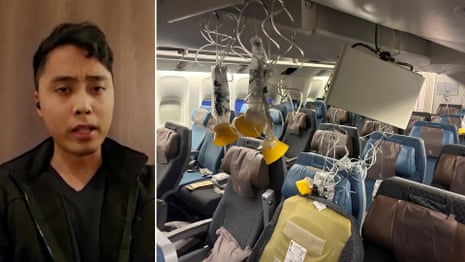 ‘Going completely horizontal’: passengers on Singapore Airlines flight hit by turbulence – video
theguardian.com
‘Going completely horizontal’: passengers on Singapore Airlines flight hit by turbulence – video
theguardian.com
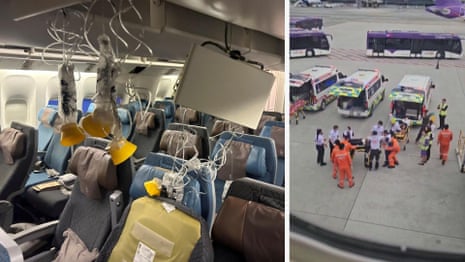 Passengers carried off Singapore Airlines plane after severe turbulence – video report
theguardian.com
Passengers carried off Singapore Airlines plane after severe turbulence – video report
theguardian.com
On 21 May 2024, Singapore Airlines flight SQ321 was crossing from London to Singapore with 210 passengers aboard, three hours from landing, when the seatbelt signs were still off and cabin crew were preparing breakfast trolleys. Over the Irrawaddy Basin in south-west Myanmar, a convective column of water vapour had built a cumulonimbus cloud rising past 35,000 feet. The Boeing 777 was passing just above it. At 2.19pm local time, moderate turbulence shook the plane for 17 seconds. Then, in 4.6 seconds, everyone not strapped down hit the cabin roof with one and a half times the force of gravity and was thrown back to the floor. One passenger died and 79 were seriously injured. The whole event lasted just over 21 seconds.
The Guardian's interactive reconstruction of the incident, built on investigation records and pilot interviews, lands on a number that sits awkwardly with the industry's public posture: according to the International Air Transport Association, turbulence is the leading cause of injuries to passengers and crew in non-fatal accidents, and Federal Aviation Administration figures record about a dozen serious injuries a year in the US alone. Some forms of the hazard are well mapped — the ten most turbulent routes on earth all cross the Andes or the Himalayas, and mountain-driven and wake turbulence can be anticipated. Convective turbulence, the kind that brought down SQ321's cabin, can strike several thousand feet above a cloud and as far as 20 miles to either side of it.
The harder problem is clear-air turbulence: wind shear in cloudless air at jet-stream altitude, invisible to radar, satellite and the pilot's eye. Researchers measuring severe episodes report they are increasing with atmospheric warming, faster than earlier models projected. Richard Woodward, a former Royal Australian Air Force test pilot and Qantas A380 captain with 32 years at the airline, puts the physics bluntly: as the planet warms, the energy feeding these events becomes massively greater. 'There's more energy in a typical thunderstorm than there is in a nuclear weapon,' he says. Airlines, he notes, are increasingly aware of the threat — awareness being the cheap part.
What no one sells is a solution. Forecasting clear-air turbulence is a collective good; the injuries are private. The available mitigations remain the seatbelt, the detour and the delay — costs an airline weighs against punctuality every time the sign stays off.