
World Bank and IMF annual meetings in Bangkok shadowed by collapsed aid budgets
Fragile states can neither borrow nor attract private capital as grants disappear, sixty years of assistance left dependence where capacity was promised
Images
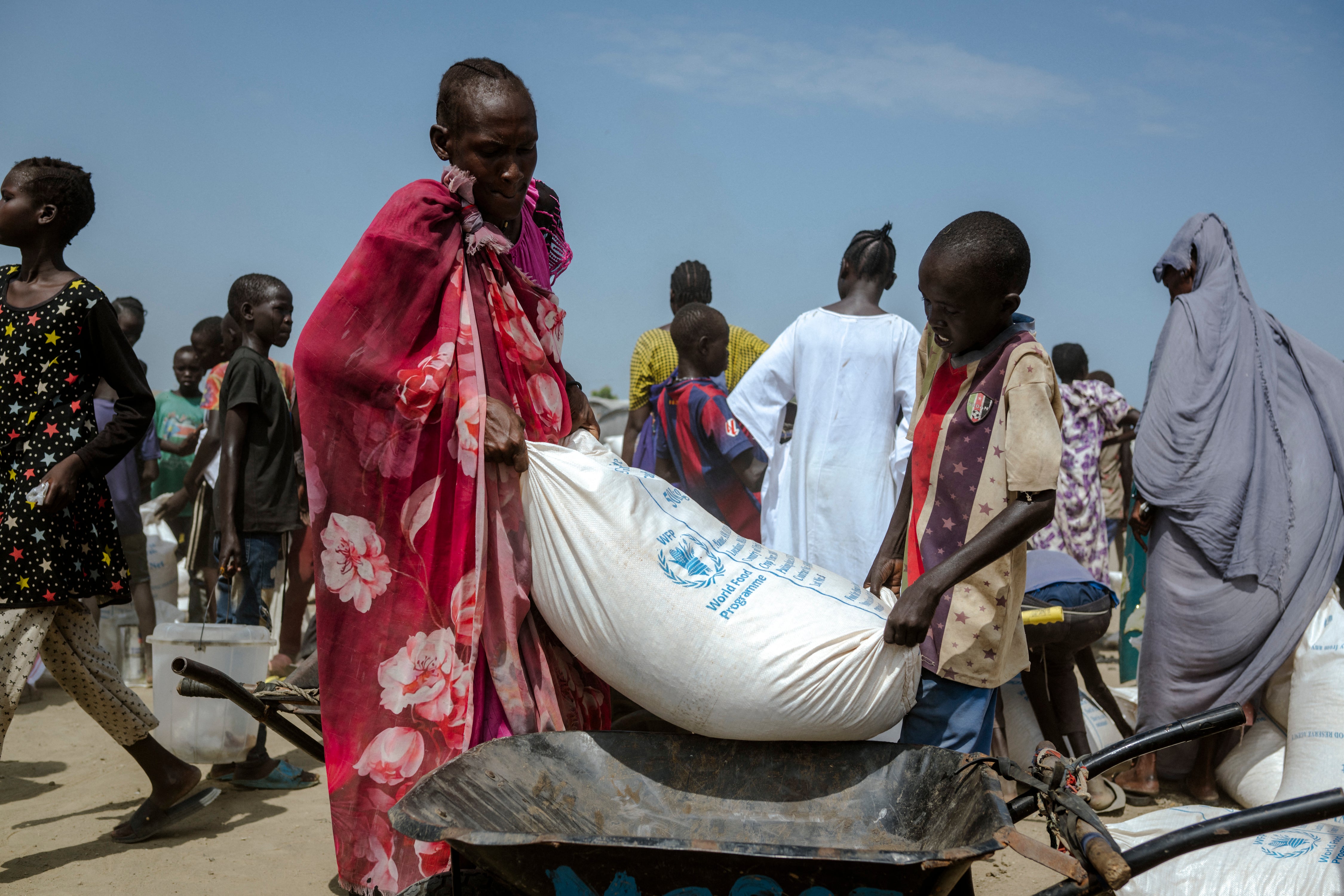 A young boy and his mother struggle to lift a heavy bag of maize into their wheelbarrow at a distribution center in the Bentiu internally displaced persons camp, Unity State, South Sudan (AFP/Getty)
AFP/Getty
A young boy and his mother struggle to lift a heavy bag of maize into their wheelbarrow at a distribution center in the Bentiu internally displaced persons camp, Unity State, South Sudan (AFP/Getty)
AFP/Getty
Nearly 20,000 people have gathered in Bangkok for the annual meetings of the World Bank and the International Monetary Fund, and the agenda is effectively a ledger of what no longer exists. USAID has been dismantled, European aid budgets are shrinking, and the officials from the world's fragile states who traveled to Thailand came, as one of them told The Independent, "as a matter of course: we have no real hope that the situation will improve."
The economics are structural rather than cyclical. Fragile states — Somalia, Chad, South Sudan, Burundi — cannot borrow, because their economies cannot service debt, and they cannot attract private capital, because investors will not commit money where governments may not outlast a project. That leaves grants, and grants are precisely what has been cut. A least-developed-country official put it flatly: unable to borrow, and with grant finance no longer arriving, the country has no financing path at all.
The meeting's main technical agenda is a set of "capital enhancement" measures — balance-sheet engineering that lets the World Bank leverage more private money alongside its lending. Clemence Landers of the Center for Global Development, speaking from Bangkok, was blunt about the limits: the measures increase how much the multilateral system can support, but they do not make lending cheaper, and no financial engineering creates grants. "The only way is for donors to fork up more money."
She also identified the obstacle to expanding the Bank's lending capacity: the United States, "the 900 pound elephant in the room", currently blocks any increase. Meanwhile the US war in the Middle East and the Hormuz closure continue to hit poor countries hardest, and this year's super El Niño is expected to devastate harvests across the Global South, plunging tens of millions into hunger.
Six decades of aid built something — but what it built, in many countries, is a budget in which donor flows are the largest single source of money, with no domestic revenue base to replace them. The withdrawal is now testing which of the two was constructed. The UK, taking on the G20 presidency, announced it will push for a "new deal" on development — a promise of money, at a meeting convened because the money left.