
Singapore threatens prosecutions over Indonesia's worst haze in a decade
Companies clearing land by fire export the cost of cheap palm oil with the wind, a transboundary pollution law that has never won a conviction gets its next test
Images
 Motorcyclists in Palangkaraya, Central Kalimantan, ride through thick orange haze caused by fires in the region. Photograph: REINA/AFP/Getty Images
theguardian.com
Motorcyclists in Palangkaraya, Central Kalimantan, ride through thick orange haze caused by fires in the region. Photograph: REINA/AFP/Getty Images
theguardian.com
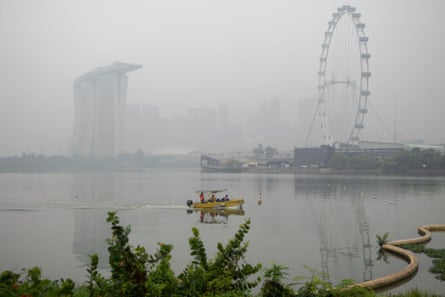 A boat passes Singapore’s Marina Bay Sands, shrouded in haze. Photograph: Feline Lim/AFP/Getty Images
theguardian.com
A boat passes Singapore’s Marina Bay Sands, shrouded in haze. Photograph: Feline Lim/AFP/Getty Images
theguardian.com
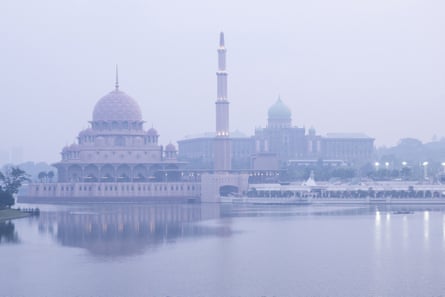 Putra Mosque and the Prime Minister’s Office in Putrajaya, Malaysia, covered in haze. Photograph: Mohd Rasfan/AFP/Getty Images
theguardian.com
Putra Mosque and the Prime Minister’s Office in Putrajaya, Malaysia, covered in haze. Photograph: Mohd Rasfan/AFP/Getty Images
theguardian.com
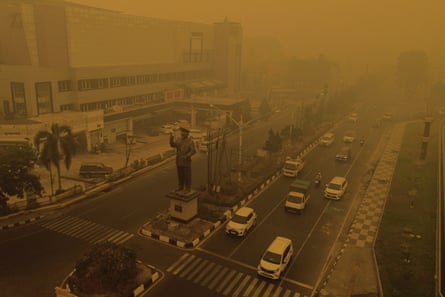 Thick smoke and haze from forest and land fires in the region in Palangkaraya, Central Kalimantan. Photograph: AFP/Getty Images
theguardian.com
Thick smoke and haze from forest and land fires in the region in Palangkaraya, Central Kalimantan. Photograph: AFP/Getty Images
theguardian.com
Singapore's government is threatening to prosecute companies responsible for some of the worst fires in Indonesia in more than a decade, as acrid smoke blankets Singapore, Malaysia, Brunei and Timor-Leste and drifts as far as the Philippines and Vietnam. Prime Minister Lawrence Wong announced on Facebook that his government was distributing masks to vulnerable citizens and "looking into which companies may be responsible for the fires," including through joint action with other countries.
The fires are not a natural disaster. Indonesia's dry season burns are largely slash-and-burn land clearing for agriculture — above all palm oil, of which Indonesia is the world's largest producer. Burning is the cheapest way to clear ground; the cost is carried downwind by everyone else's lungs. Several companies holding Indonesian concessions are reportedly based in Singapore itself, which gives the city-state legal reach it has so far declined to use: its Transboundary Haze Pollution Act has never produced a single successful prosecution.
Millions are affected. Schools have closed and respiratory illness has spiked as air pollution indexes hit unhealthy levels across the region. Malaysian veteran activist Lee Lam Thye wrote in a public letter this week: "Year after year, the haze comes back. It affects our health, closes schools, hurts businesses, and costs us billions." Real enforcement, he wrote, requires that those responsible be "named, investigated, and punished. Clean air is not a favour. It is a basic right."
Indonesia's response has oscillated between defiance and acceptance of help. On Monday an official said the country was "still capable of handling it"; by week's end Jakarta said it would accept assistance. On Saturday, Syahganda Nainggolan, head of Indonesia's government communication agency, went viral with a rebuttal: "We don't only send haze, the oxygen in Singapore and Malaysia comes from our forests." Malaysian Prime Minister Anwar Ibrahim said he had spoken with Indonesia's President Prabowo Subianto, who "agreed to take the necessary steps" — a commitment Anwar insisted must be followed by "immediate and effective action."
The diplomatic friction tests Asean's founding doctrine of quiet engagement and non-interference, with regional foreign ministers due to meet in the Philippines next month. The pattern is familiar from previous seasons: enforcement powers exist on paper in Singapore, but pursuing plantation companies means confronting an industry that spans borders, ownership structures and political friendships in Jakarta.
The smoke this year reached the same Indonesian province — Central Kalimantan — where fires are threatening the Gunung Palung orangutan research station. The clearance burns that darken Singapore's skyline and the ones closing a 32-year-old scientific dataset are the same fires, lit for the same reason.