
Blue Origin bets everything on New Glenn launch cadence, two more pads and 150 upper stages a year planned in Florida
A company with two orbital launches designs for 150 flights while SpaceX steps back from commercial customers
Images
 Credit:
Blue Origin
Credit:
Blue Origin
 Photo of Eric Berger
arstechnica.com
Photo of Eric Berger
arstechnica.com
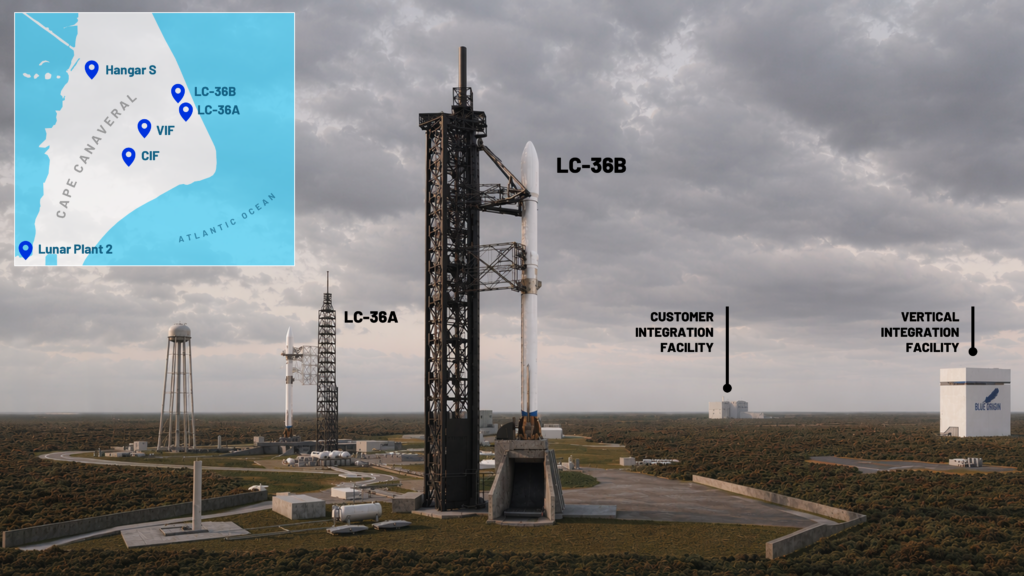
Blue Origin announced a major expansion of its Florida launch facilities on Friday, adding two more launch pads for the New Glenn rocket and a manufacturing plant designed to produce up to 150 upper stages a year. Ian Richardson, the company's senior vice president of operations, said the infrastructure is designed to support multiple flights per week by the end of the decade.
The company has invested roughly $3 billion in Florida so far, employs more than 5,000 people in the state, and counts 500 suppliers there. Two New Glenn pads are already under construction at Cape Canaveral, and Blue Origin plans to procure two additional landing ships — it currently operates one, named Jacklyn — to catch and return first stages. A new customer integration facility, built with the US Space Force, will have four payload bays to process several missions simultaneously.
The scale of the bet is best read against the scoreboard. SpaceX has launched hundreds of rockets to orbit from Florida; Blue Origin has launched twice. The New Glenn program stalled in late May when a BE-4 engine problem destroyed a vehicle along with its only launch site, Launch Complex 36A, and the company is now rebuilding that pad for a return to flight — with launches realistically resuming in early 2027. The newly announced pads are likely sized for the larger 9×4 variant of New Glenn, with nine first-stage engines against seven on the smaller version, capable of carrying 70 tons to low-Earth orbit.
What has changed is the customer side of the market. According to Ars reporting, commercial satellite customers have struggled to buy a Falcon launch beyond 2028, as SpaceX pulls back from the commercial market with Falcon 9 and Falcon Heavy. That leaves a queue of satellite operators with money ready and nowhere to send it — and Blue Origin, for a quarter-century financed by Jeff Bezos's personal fortune without a profit deadline, now has a market waiting if it can actually fly.
The company that spent 25 years building infrastructure without flying much of anything is now racing to turn pads, barges and factories into launch cadence. Richardson's stated goal is 150 rockets a year from Florida.