
Maduro tells New York court torture charges are false
Shackled ex-president refuses to enter plea as rewritten indictment abandons drug case for alleged state torture system, wife Cilia Flores declares innocence while both sides quietly push trial back two weeks
Images
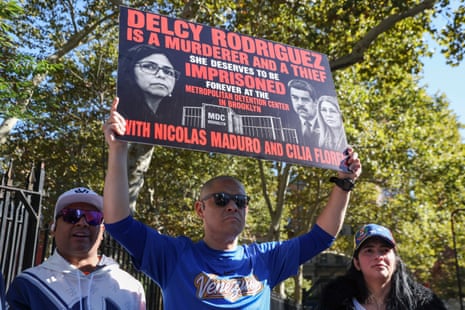 People protest against Nicolás Maduro and his wife Cilia Flores outside a federal courthouse in New York on Thursday. Photograph: Sarah Yenesel/EPA
theguardian.com
People protest against Nicolás Maduro and his wife Cilia Flores outside a federal courthouse in New York on Thursday. Photograph: Sarah Yenesel/EPA
theguardian.com
Nicolás Maduro stood shackled at the ankles before a federal judge in Manhattan on Thursday, telling the court that new torture charges against him and his wife Cilia Flores were built on "false accusations and false testimony." Judge Alvin Hellerstein entered a not-guilty plea on his behalf after Maduro twice declined to do so himself.
The rewritten indictment no longer leads with drug trafficking. It accuses Maduro and Flores — she a former attorney general, he president of Venezuela from 2013 until his capture — of running a state-sponsored torture system that beat, asphyxiated and electrocuted scores of victims, including three Americans. Prosecutors say Maduro personally recommended torture methods and received updates on specific prisoners; one allegation has him threatening to kill a detainee's child as psychological pressure. Flores, 70, told the court through an interpreter: "I am completely innocent. I am not guilty."
The couple was seized from their Caracas home by the US military in a night-time raid in January. The drug case that originally justified the operation now sits alongside a torture indictment stretching back to Maduro's ascent to power in 2013 — the same conduct the International Criminal Court has investigated for years without ever bringing him to The Hague.
The legal novelty is real: torture is prosecutable anywhere under international law, but the United States has tried foreign officials only a handful of times — the son of Liberia's Charles Taylor, Russians for war crimes in Ukraine, a warden in Assad's Syria. The defense argues the entire case should be dismissed because the defendants were, at the time, the leader and first lady of a sovereign country.
There is also the question the courtroom will not resolve. Washington spent months constructing a settlement architecture around Caracas — oil concessions across Venezuelan fields, frozen gold in the Bank of England held as a bargaining chip between the government and the opposition. Those arrangements require someone on the Venezuelan side able to sign. A trial that keeps Maduro in a New York cell for years removes the counterparty, and a plea or a political deal removes the trial. Prosecutors, for their part, asked to move the trial date from June 1 to June 14 — both sides, they told the judge, want the delay.
Outside the courthouse, protesters gathered against the man who ran Venezuela for thirteen years. Inside, the judge entered a plea the defendant would not.