
Baku gathers friends and foes at rare Asian summit, Israel's president and Iran's deputy foreign minister under one CICA roof
Trans-Caspian fibre cable inaugurated as Eurasian corridors route trade around the Gulf
Images
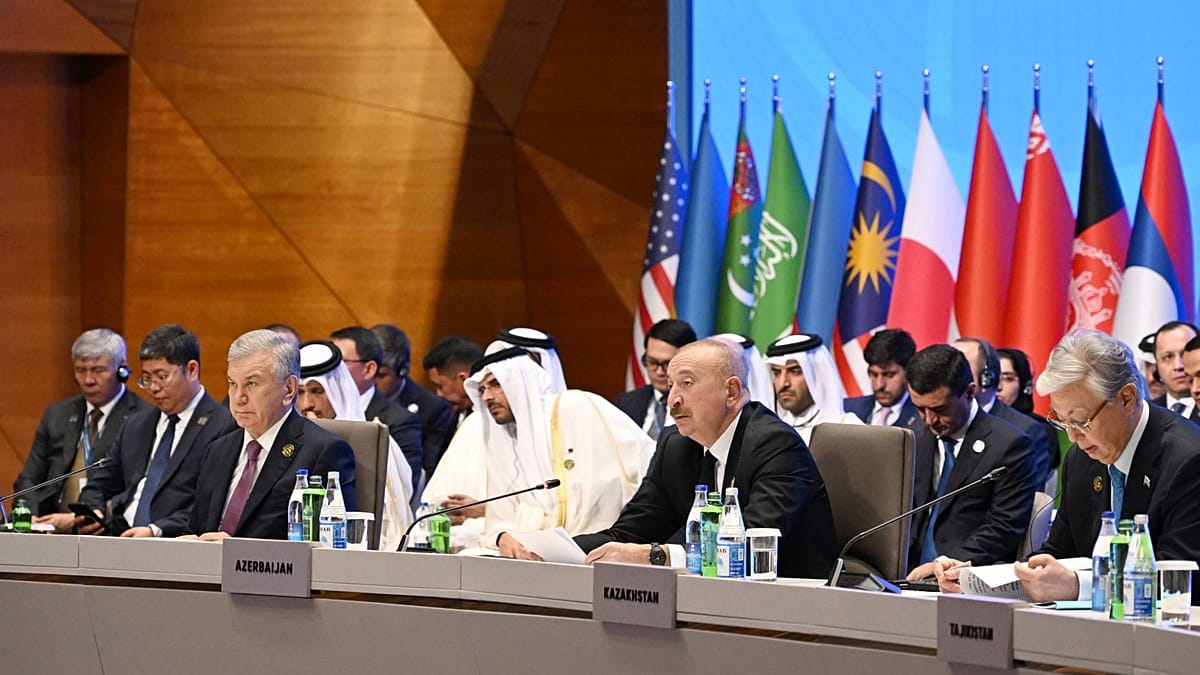 Middle East and Asian leaders gather in Baku despite disagreements
euronews.com
Middle East and Asian leaders gather in Baku despite disagreements
euronews.com
Israel's president, Iran's deputy foreign minister, Russia's foreign minister and China's top diplomat took seats in the same hall in Baku on Thursday, as Azerbaijan hosted the seventh summit of the Conference on Interaction and Confidence-Building Measures in Asia — a forum created to build trust, and a guest list drawn from opposite sides of active conflicts.
The attendance ran from Isaac Herzog to Kazem Gharibabadi, from Sergey Lavrov to Wang Yi, with Qatar's emir Sheikh Tamim bin Hamad Al-Thani, Turkey's foreign minister Hakan Fidan, a UAE minister of state, and a Palestinian delegation led by foreign minister Varsen Aghabekian Shahin. The presidents of Uzbekistan, Kazakhstan, Kyrgyzstan and Tajikistan came, as did heads of state and government from India, Vietnam, Sri Lanka, Cambodia and Laos. Euronews reports the gathering produced tense moments between leaders on opposing sides, alongside bilateral meetings on the margins.
President Ilham Aliyev, who engineered the guest list, cast his country as a connecting hub in the Eurasian space. The working agenda was transport. Kazakhstan's President Kassym-Jomart Tokayev proposed a CICA transport connectivity strategy and pointed to a strategic partnership signed last year between Kazakhstan, Azerbaijan and Uzbekistan, along with documents founding a Caspian green energy corridor that would carry power to the European market via the Black Sea — with benefits flowing through the Baku-Tbilisi-Ceyhan pipeline.
The concrete deliverable was digital. Aliyev and Tokayev inaugurated a fibre-optic cable laid across the Caspian seabed, running from China and Central Asia toward Europe through the Black Sea, described as a key component of the Middle Corridor project — the trans-Caspian route that connects Asia to Europe without passing through the Gulf.
Uzbekistan's President Shavkat Mirziyoyev called for an "infrastructure of trust in Asia" built on transport and energy projects that would prevent future conflicts: "when dialogue weakens, the risk of wrong decisions being made increases." Kyrgyz President Sadyr Japarov told the hall that UN reports put Asia's share of global economic development this year at 59 percent.
Most leaders declared their commitment to expand coordination across the Eurasian space. Tokayev observed that the 21st century has already been called the Asian century — and that whether it becomes an era of peace or an era of division remains to be settled.
The fibre line inaugurated on Thursday runs from China through Central Asia to Europe via the Black Sea, touching neither Suez nor Hormuz.