
Leap second makes way for the leap hour
Delegates from 69 countries in Versailles let UTC drift a full hour from Earth's rotation, prospect of the first-ever deleted second forced the vote
Images
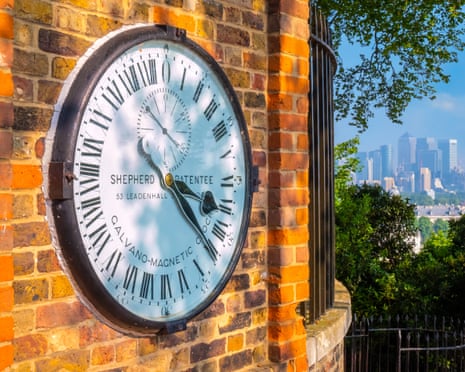 A clock at the Royal Observatory, Greenwich, through which the prime meridian passes. Photograph: coward_lion/Getty Images
theguardian.com
A clock at the Royal Observatory, Greenwich, through which the prime meridian passes. Photograph: coward_lion/Getty Images
theguardian.com
 Computers linked with the atomic clock at the National Physical Laboratory in Teddington, England, and other international atomic clocks. Photograph: David Gee/Alamy
theguardian.com
Computers linked with the atomic clock at the National Physical Laboratory in Teddington, England, and other international atomic clocks. Photograph: David Gee/Alamy
theguardian.com
Delegates from 69 countries voted at Versailles on Thursday to abolish the leap second and replace it with the leap hour. From next year, coordinated universal time — UTC — may drift a full hour away from the Earth's rotation before a single correction is inserted, an adjustment the timekeepers themselves do not expect to need for thousands of years.
The vote at a conference of the International Bureau of Weights and Measures, the body that keeps the world's standards of time, weight and distance in agreement, ends more than 50 years of splicing extra seconds into the world's clocks. Since 1972, 27 leap seconds have held atomic time in step with the turning planet, and each has been a hazard for the computer systems, communications networks, satellites, trading platforms and electricity grids that now depend on precise time — software that expects 60 seconds to the minute grapples with minutes that last 61 or 59.
What forced Thursday's decision was not the familiar insertion but its opposite. The Earth's rotation has sped up over the past decade, and the expert committee that proposed the leap hour put a 30 per cent probability on the first negative leap second — a second deleted from UTC — arriving within the next decade. No system anywhere has ever handled one. Rather than find out what breaks, the delegates chose to let the discrepancy accumulate toward a correction no one alive will see.
The planet's spin is nudged by its molten core, shifting oceans and global jet streams, and slows over the long run; when an asteroid doomed the dinosaurs, a day lasted about 23 and a half hours. The second itself stopped being astronomical in 1967, when it was redefined as 9,192,631,770 vibrations of a caesium atom — a standard made possible by the first practical caesium clock, built by Louis Essen and Jack Parry at the National Physical Laboratory in Teddington in 1955.
"After 30 years of debate, the leap second is making way for the leap hour," said Dr Setnam Shemar, principal scientist in the NPL's time and frequency department and a member of the committee behind the proposal. He compared the eventual correction to daylight saving, "where we change by an hour and no one gets bothered about that."
The systems that run on atomic time get clocks that never surprise them; the sky keeps its own schedule. The prime meridian still passes through the Royal Observatory at Greenwich, where the clocks were once set by the sun — which is now permitted to run up to an hour behind them.