
Protected sand tiger sharks leave Delaware Bay for foreign aquarium tanks
80 legally collected since 2018 with 40 taken in one year, anglers must release what permit holders ship to China and Abu Dhabi
Images
 A marine researcher measures a male sand tiger shark in Delaware Bay, which has become a hotspot for the collection of sharks for the aquarium trade. Photograph: Maya Yang/The Guardian
theguardian.com
A marine researcher measures a male sand tiger shark in Delaware Bay, which has become a hotspot for the collection of sharks for the aquarium trade. Photograph: Maya Yang/The Guardian
theguardian.com
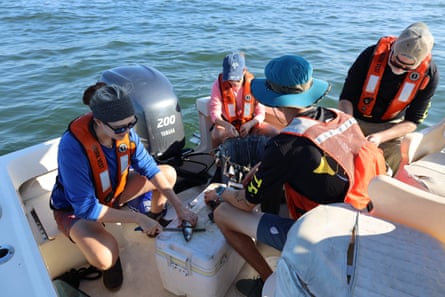 Aaron Carlisle prepares mackerel bait in Delaware Bay with other colleagues from the University of Delaware’s School of Marine Science and Policy. Photograph: Maya Yang/The Guardian
theguardian.com
Aaron Carlisle prepares mackerel bait in Delaware Bay with other colleagues from the University of Delaware’s School of Marine Science and Policy. Photograph: Maya Yang/The Guardian
theguardian.com
 A sand tiger shark (centre) at SeaWorld Abu Dhabi, the United Arab Emirates, March 2024. Photograph: CTK/Alamy
theguardian.com
A sand tiger shark (centre) at SeaWorld Abu Dhabi, the United Arab Emirates, March 2024. Photograph: CTK/Alamy
theguardian.com
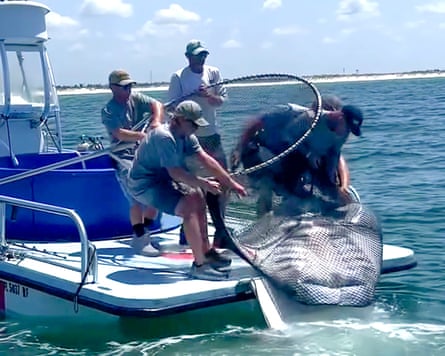 Fishers off the coast of Panama City beach in Florida in 2025, catching a giant manta ray for SeaWorld Abu Dhabi. Photograph: Facebook/Planet Water USA
theguardian.com
Fishers off the coast of Panama City beach in Florida in 2025, catching a giant manta ray for SeaWorld Abu Dhabi. Photograph: Facebook/Planet Water USA
theguardian.com
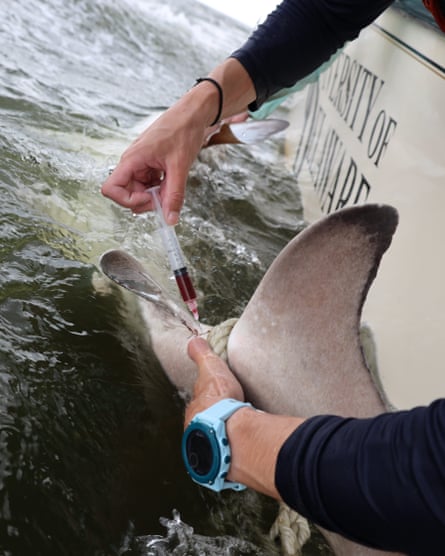 A blood sample is taken from the underside of a male sand tiger shark in Delaware Bay. Photograph: Maya Yang/The Guardian
theguardian.com
A blood sample is taken from the underside of a male sand tiger shark in Delaware Bay. Photograph: Maya Yang/The Guardian
theguardian.com
Shortly after 12.45pm in Delaware Bay, a sand tiger shark took a mackerel chunk set on a 300-metre line. Researchers from the University of Delaware hauled it toward their boat — a mature male, 225 centimetres long with a 90-centimetre girth — measured it, took blood and muscle samples, fastened a tag beneath its dorsal fin and put it back in the water. Other sand tigers pulled from the same bay travel differently: to display tanks in Abu Dhabi, where day passes sell for up to $100.
A study by marine researchers at the University of Delaware, Delaware State University and the University of Rhode Island, drawing on data from Delaware's Department of Natural Resources and Environmental Control, counts 80 sand tiger sharks taken from Delaware waters for aquariums between 2018 and 2024. The annual total rose from two specimens in 2018 to 40 in 2023, and nearly all went overseas — the largest numbers to China and the United Arab Emirates, with others to South Korea, Thailand, Turkey, Scotland, Israel, Italy, France and Uzbekistan. A few stayed in the United States.
The sand tiger shark is critically endangered globally and prohibited from being caught in US waters. Delaware Bay, between Delaware and New Jersey, is a habitat of particular concern — and in recent years, a hotspot for private collection of specimens for the global aquarium trade. A maze of federal and state permits lets private companies legally remove the protected animals for public display. An angler who hooks a sand tiger must release it; a collector with the right paperwork can load it onto a flight.
Brad Wetherbee, a University of Rhode Island researcher who co-wrote the study, compares the trade to going into Yellowstone and catching wolves to sell to zoos in France or the Middle East. The countries buying the sharks, he notes, once had sand tigers in their own waters — their populations are now too low to collect there.
The United States has spent decades restricting the killing of sand tiger sharks. A shark collected from Delaware Bay never returns to Delaware Bay.