
Rotterdam's bin lorries join the Netherlands' intangible heritage list
Poems have ridden the city's waste fleet since 1988, verse reaches every street on a collection schedule
Images
 A Rotterdam road sweeper. The poem by Alfred Schaffer translates as: ‘And one more step, and step by step, I step away from myself’. Photograph: Irene Hoekstra
theguardian.com
A Rotterdam road sweeper. The poem by Alfred Schaffer translates as: ‘And one more step, and step by step, I step away from myself’. Photograph: Irene Hoekstra
theguardian.com
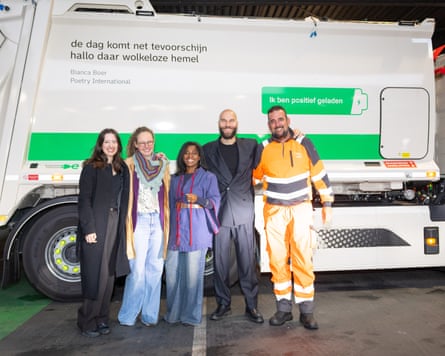 Rotterdam municipality celebrated the intangible heritage listing and unveiled its latest poetic lorries on Tuesday. Photograph: Rhalda Jansen Fotografie
theguardian.com
Rotterdam municipality celebrated the intangible heritage listing and unveiled its latest poetic lorries on Tuesday. Photograph: Rhalda Jansen Fotografie
theguardian.com
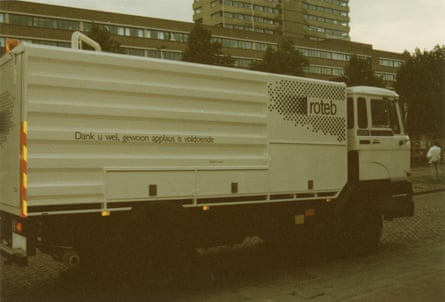 A poem by Roland Jooris, on the side of a Roteb garbage truck as part of the Poetry International project in 1988, reads: ‘Thanks, just some applause is enough’. Photograph: Rotterdam Stadsarchief
theguardian.com
A poem by Roland Jooris, on the side of a Roteb garbage truck as part of the Poetry International project in 1988, reads: ‘Thanks, just some applause is enough’. Photograph: Rotterdam Stadsarchief
theguardian.com
Rotterdam's bin lorries have carried poems on their flanks since 1988. This week the tradition was formally added to the Netherlands' inventory of intangible cultural heritage, on a plan put to the heritage body jointly by the municipality and Poetry International — the festival that first put verse on the waste fleet. The city unveiled its latest poetic lorries on Tuesday.
The recognition comes from the Dutch Centre for Intangible Cultural Heritage, which keeps an inventory of more than 400 traditions, crafts, rituals and customs, a list that runs from Pride Amsterdam's canal parade to the country's ten remaining shepherded flocks. Rotterdam's entry is a dustcart. "Since 1988, poetry has been travelling through Rotterdam on our bin lorries," says Joan Nunnely, the deputy mayor for culture, community and language. "You see it as you cycle to work or wait for a lorry to pass. Sometimes you read a line that stays with you for the rest of the day."
Nunnely frames the listing against a narrow view of poetry's audience: "Sometimes people think about culture as something only for those with a theoretical education. This is one way to bring poetry to all Rotterdammers." Diana Chin-A-Fat, director of Poetry International, puts the reach more bluntly: "Every Rotterdammer recognises it. Every Rotterdammer reads it."
The crews have their own relationship to the cargo. Paul Keijzer, who started driving Rotterdam's litter trucks in the tradition's first year, says the verse gives waste workers an added connection to the city and has moved him to write the odd line himself. He has driven four of the poem lorries, and the reactions are largely positive — "sometimes they say: I don't understand that line!" The poet Derek Otte, whose own words recently joined the fleet, describes the founding idea as combining "something beautiful like poetry with something beautiful in a different way, like the garbage trucks."
Keijzer's current truck carries a verse by Neeltje Maria Min: "The longer I look back, the tighter the knot in time."