
London museum drawer yields new dinosaur species after nearly a century
Invictibellatrix amberina was a two-legged carnivore related to Tyrannosaurus rex, the fossil entered the collection in 1924
Images
 Watch: French student protests turn chaotic
cbsnews.com
Watch: French student protests turn chaotic
cbsnews.com
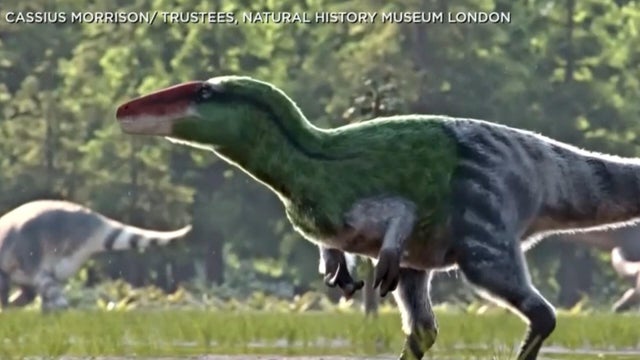 Scientists discover new dinosaur species
cbsnews.com
Scientists discover new dinosaur species
cbsnews.com
 OpenAI sued over alleged child harm
cbsnews.com
OpenAI sued over alleged child harm
cbsnews.com
 Teen's kind deed caught on camera
cbsnews.com
Teen's kind deed caught on camera
cbsnews.com
 Inside the search for Amelia Earhart
cbsnews.com
Inside the search for Amelia Earhart
cbsnews.com
A fossil that sat in a drawer at the Natural History Museum in London for nearly a century has been identified as a new species of dinosaur. Researchers in the UK named it Invictibellatrix amberina, a two-legged carnivore and a relative of Tyrannosaurus rex. The museum acquired the specimen in 1924.
The discovery required no expedition. The material was already owned, catalogued and forgotten, and the work that produced a species name happened inside the building, where comparative anatomy and modern imaging can read bones that earlier generations had no tools to interpret. CBS News, which reported the find, has published an animation depicting the animal.
Field seasons cost money, permits and years. Walking past the storage racks behind the public galleries a second time costs nothing new, and many new species descriptions now come from exactly that: re-examining inventory that institutions already hold rather than digging up what they do not. Museums display a fraction of what they store, and each generation of scanning equipment finds another layer of unread material in the collections. Palaeontology in particular has a long habit of this — specimens collected decades ago regularly enter the literature as new species once someone re-reads them with better tools.
Until a specimen is named, it is inventory. Named, it becomes a research programme, an exhibit, a press release and a line on a funding application. The same arithmetic governs living animals, where the decision to call a population one species or two determines which protection lists it enters and which money follows it.
The fossil arrived at the museum in 1924. The name arrived a century later, without the specimen ever leaving the building.