
Salling Group trains humanoid robots for supermarket night shifts
Unitree bodies guided by VR operators learn shelving in a working Føtex store, Nordic night-shift wages make Denmark the first market where the maths works
Images
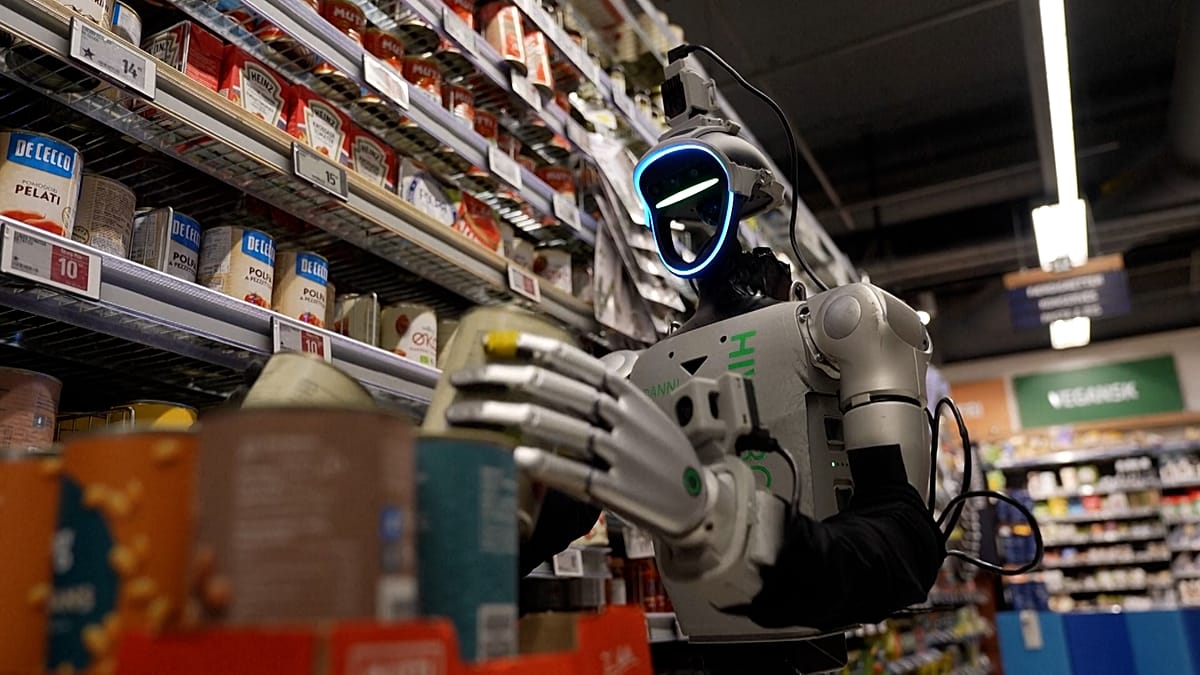 Night-shift robots: Danish supermarket trains humanoids to restock
euronews.com
Night-shift robots: Danish supermarket trains humanoids to restock
euronews.com
Humanoid robots are learning to restock supermarket shelves after closing time at a Føtex store in Lyngby, north of Copenhagen. Training began in June at the chain owned by Salling Group, Denmark's largest retailer, which operates more than 2,100 stores across Denmark, Germany, Poland, Latvia, Estonia and Lithuania.
The division of labour is precise. Hive Robots, a Danish start-up, develops the software and trains the machines; the bodies — arms, legs and fingers, able to work in aisles built for people — come from the Chinese manufacturer Unitree. In a corner of the store, a human operator in virtual-reality glasses with handheld controllers guides a robot as it picks up pasta bags and places them on shelves. The demonstrations become the training data. "There are a lot of small things that we as humans don't think about that basically we need to teach the robot," says Roger Sala, a robot pilot at Hive Robots.
The machines are currently slower than supermarket workers. Hive says advances in AI will improve their speed and precision, and hopes they can restock some products unaided at night by early 2027. Stores would pay by the hour for the service.
Føtex estimates that restocking accounts for 40 to 50 per cent of staff time, and the chain says it struggles to recruit young workers for the task. Night shelving is the most automatable job in retail — the store is empty, the task repeats — and the robot does not need to beat a human at it, only to undercut a Danish night-shift wage. Nordic labour costs make the payback calculation work here before almost anywhere else, which is why the apprenticeship runs in a working store rather than a laboratory. Salling is simultaneously test bench, first customer and reference sale: whatever survives Danish nights becomes an export product for every European chain running the same wage arithmetic. Operations director Simon Kudsk allows up to five years before every store has its humanoid — the stated vision is one or two per Føtex, freeing colleagues for customers — with further tasks to include spotting missing or misplaced products, removing empty cardboard and checking best-before dates.
The IMF estimated in 2024 that AI could change how around 60 per cent of jobs across the EU are done. Salling says the trial is meant to support employees rather than replace them, and the job being automated first is the one it cannot recruit for.
The robots are still slower than the people generating their training data; the hourly price has not been announced.