
EU sends epidemiologists to Congo Ebola epicentre
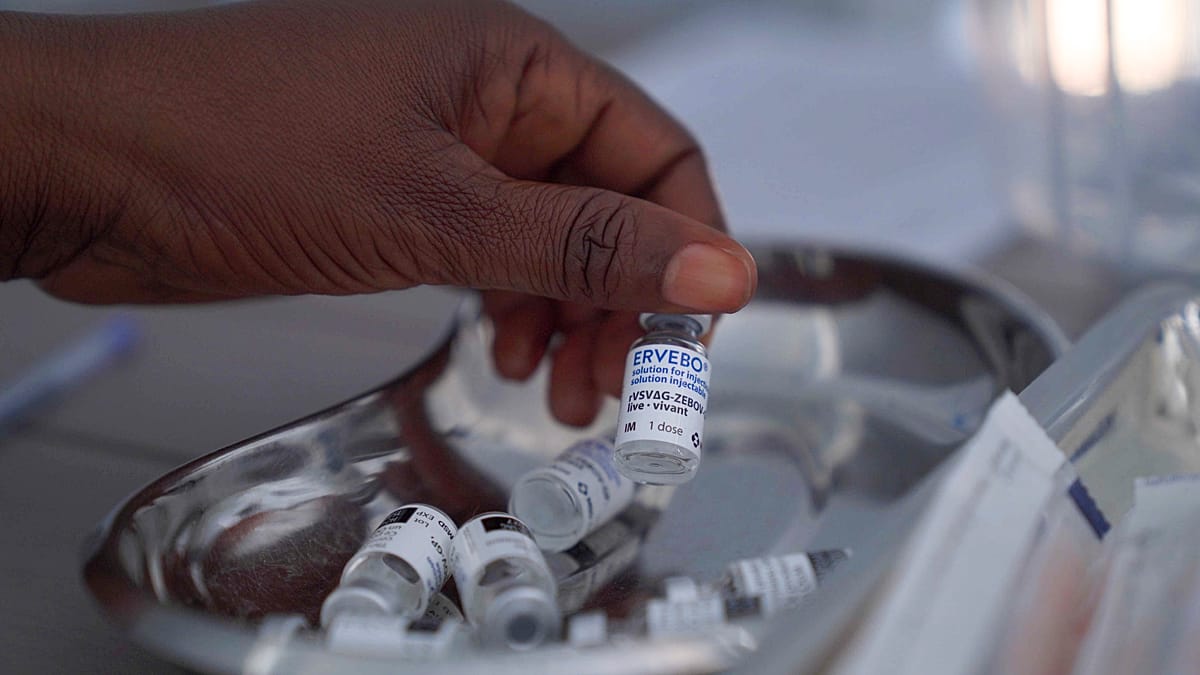
WHO starts Ervebo research vaccination against Bundibugyo strain, outbreak response leans on trials because no licensed vaccine exists
Images
 EU sends experts to Congo as Ebola outbreak continues
euronews.com
EU sends experts to Congo as Ebola outbreak continues
euronews.com
Two European epidemiologists are being sent to the epicentre of the Democratic Republic of Congo’s Ebola outbreak as health authorities begin a research vaccination programme using the Ervebo vaccine, according to Euronews. The European Centre for Disease Prevention and Control (ECDC) said the experts will reinforce surveillance and the wider response effort, adding to support it has provided since the outbreak began. The World Health Organization announced the start of the vaccination research programme in Ituri province, where nearly 80% of infections have been recorded.
The numbers attached to the outbreak underline why external capacity is being pulled in. Euronews cites latest health authority data showing more than 7,600 confirmed cases and over 3,670 deaths. The outbreak is being driven by the Bundibugyo virus, for which there is no licensed vaccine or treatment, leaving responders to rely on containment measures—case finding, isolation, safe burials, and contact tracing—that require staffing, logistics and public trust. The ECDC said it has been providing direct support since May, with experts deployed to support the Africa CDC, and that it led an assessment of exit screening at airports in the DRC and Uganda in June. It has also deployed experts to South Sudan, reflecting how outbreak control often becomes a regional exercise once cross-border movement is treated as a planning assumption.
The vaccine component is both a tool and an admission of uncertainty. WHO said 20,000 doses of Ervebo have been allocated for a study assessing protection against Bundibugyo disease, and that 70,000 doses have been made available to Congolese authorities to support response and related research. Ervebo proved highly effective against the Ebola Zaire virus, but Euronews notes it is not yet known whether it can provide meaningful protection against Bundibugyo. That puts the vaccination programme in the category of field research conducted under pressure: it may reduce risk for health workers and frontline personnel, but it does not remove the need for the slower, less visible work of surveillance and community engagement.
European agencies are also calibrating the political message around importation risk. The ECDC said the risk to Europeans remains very low, while acknowledging that sporadic importations into the European Union could occur and that multiple independent importations are unlikely even if case numbers rise. Such statements tend to travel in two directions at once: reassurance for domestic audiences, and justification for funding and deployments abroad framed as prevention at the source.
In Ituri, the immediate constraint is not a shortage of declarations but the ability to keep track of cases and contacts in real time. Euronews’ report makes clear that the EU’s contribution, for now, is measured in two epidemiologists and vaccine doses whose effectiveness against this strain remains under study.