
EU weighs reinforcing Operation Aspides
Italy warns Bab el-Mandeb escorts are running on too few hulls, national convoys creep into a common mission
Images
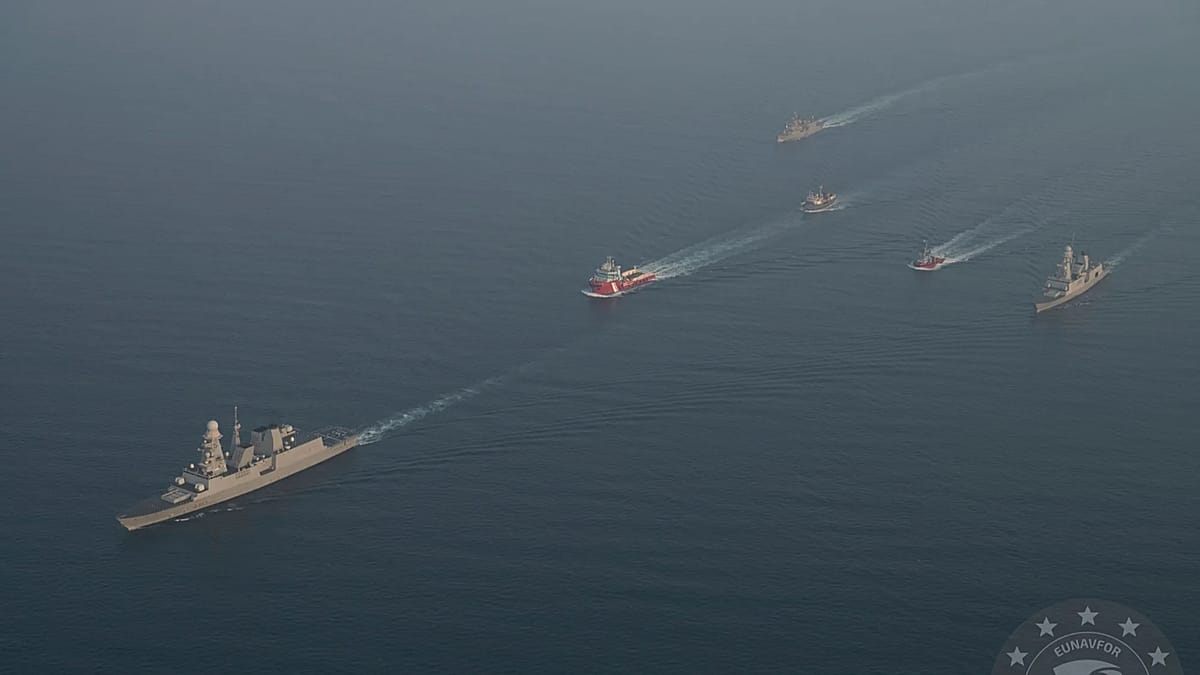 Kallas pushes to boost EU mission against Houthis
euronews.com
Kallas pushes to boost EU mission against Houthis
euronews.com
Italy and Greece are asking other EU capitals for more ships and aircraft in the Red Sea after Houthi advances tightened their grip around the Bab el-Mandeb strait, according to Euronews. In a letter dated 19 September, EU foreign policy chief Kaja Kallas urged member states to reinforce Operation Aspides, the bloc’s defensive naval mission launched in 2024 to protect merchant vessels transiting between the Indian Ocean and the Mediterranean.
The immediate trigger, Euronews reports, was an escort operation off Yemen in which an Italian frigate accompanied an Italian merchant vessel, prompting Italy’s defence minister Guido Crosetto to warn that Europe’s presence is too thin. Kallas asked for “more suitably equipped” naval and air assets and greater capacity for close protection, a request that implicitly acknowledges the limits of a mission that can use force but is designed to stay narrowly focused on shipping defence.
Aspides has relied on a small core contribution—Italy and Greece providing the operation’s three core ships—temporarily supplemented by vessels from Germany, France, Spain, the Netherlands and Belgium. That model works when attacks are sporadic and the coastline is contested; it strains when the group launching the attacks holds terrain. The Houthis have seized Mocha, Perim Island and the Hanish Islands, according to Euronews, giving them leverage over a chokepoint that matters to European energy and consumer prices.
The politics of reinforcement are as important as the hardware. Crosetto has complained that only two European warships were present in the area last week and said Italy would not wait for Europe if further escorts were needed for national cargo vessels—an admission that, in practice, states already prioritise their own hulls and their own insurers. French and Dutch units are reported to be operating to protect their own merchant fleets, a pattern that turns a common mission into a patchwork of national carve-outs.
Italy has floated basing additional ships in Djibouti, but Euronews notes that securing approval—and, crucially, funding support from allies—would be difficult. Analysts cited in the report argue that naval deployments alone may be inadequate and call for air cover against Houthi control of parts of Yemen’s coast, a step that would widen both cost and risk for governments that have sold Aspides as a limited, defensive operation.
EU defence ministers are set to discuss the issue on 28 September in Brussels, with the Foreign Affairs Council scheduled to return to it on 12 October in Luxembourg. By then, the operational question may be less about mandates than about whether enough European states are willing to underwrite routine protection of commercial traffic that, for many companies, has already become a line item in freight rates and war-risk premiums.