
US proposes AI incident alert system with China
Biden-era chip controls stay in place as Trump and Xi prepare to meet, Xinhua readout mentions AI but omits the proposal
Images
 US-CHINA-TRADE
nbcnews.com
US-CHINA-TRADE
nbcnews.com
 Stocks advance after Bessent says talks with China were successful before Trump-Xi meeting
independent.co.uk
Stocks advance after Bessent says talks with China were successful before Trump-Xi meeting
independent.co.uk
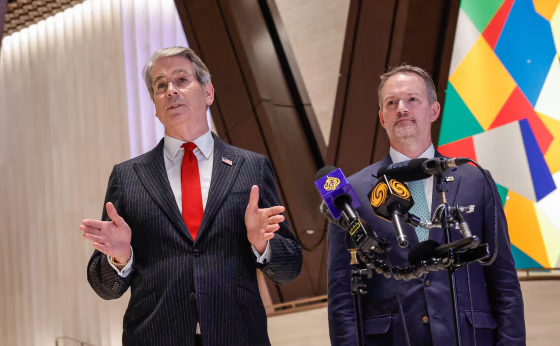
The United States has proposed a new notification mechanism for artificial-intelligence incidents to be shared with China ahead of a planned summit between President Donald Trump and Chinese leader Xi Jinping in Washington on September 24. Treasury Secretary Scott Bessent disclosed the idea after talks in New York with Chinese officials, according to NBC News. The proposed system would cover AI-related incidents that could affect national security, alongside a new bilateral dialogue on AI.
The timing is not subtle. The same talks are also being used to test whether a trade truce due to expire in early November can be extended, and whether tariffs on “non-sensitive” goods can be lowered, NBC reports. In practice, the U.S. is offering more structured communication about fast-moving AI risks while keeping the hard constraints in place: U.S. Trade Representative Jamieson Greer said the AI channel would not change export controls on advanced chips and semiconductor manufacturing equipment. That matters because those controls are one of the main levers shaping China’s AI trajectory, and they sit outside any voluntary “safety” conversation.
China’s public readout offered little reinforcement. NBC notes that Xinhua mentioned AI discussions but did not mention the U.S. proposal, even as Bessent described the engagement as successful. That asymmetry is a familiar feature of U.S.-China crisis-management efforts: Washington often seeks a hotline-like structure to reduce the chance of miscalculation, while Beijing resists arrangements that look like constraints, admissions of vulnerability, or validation of U.S. framing.
The proposal also lands amid a split-screen debate inside the U.S. itself. NBC reports that prominent AI leaders have warned of existential risks within a few years, while Trump has dismissed such warnings as a “hoax,” even as he shares the same executives’ insistence that the U.S. must not let China pull ahead. The result is a policy posture that treats AI as both a safety hazard and a strategic race, with different agencies tasked to pursue each goal without conceding leverage.
If the two sides do agree to exchange incident alerts, it would not resolve the larger question of what counts as an “incident,” who verifies it, and what consequences follow when one party claims harm. For now, the only concrete detail is that both sides agreed to meet again on the AI issue.
The Chinese officials who met Bessent in New York did not comment to reporters afterward, and Xinhua’s summary did not mention the proposed alert mechanism.