
US indictments allege Russian-linked plot to kill dissident in Washington
Kremlin critics say taboo on assassinations in America may be fading, Europe watches safe havens shrink
Images
 The Russian investigative journalist Roman Dobrokhotov has been the target of an assassination plot in the UK, but now fears Russia extending its reach to the US. Photograph: Andy Hall/The Observer
theguardian.com
The Russian investigative journalist Roman Dobrokhotov has been the target of an assassination plot in the UK, but now fears Russia extending its reach to the US. Photograph: Andy Hall/The Observer
theguardian.com
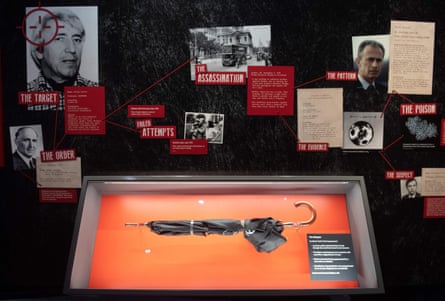 An umbrella similar to the one the KGB used to kill dissident Georgi Markov at the International Spy Museum in Washington DC. Photograph: Saul Loeb/AFP/Getty Images
theguardian.com
An umbrella similar to the one the KGB used to kill dissident Georgi Markov at the International Spy Museum in Washington DC. Photograph: Saul Loeb/AFP/Getty Images
theguardian.com
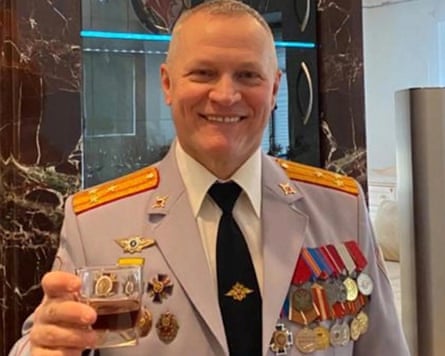 Col Yuri Khrameev of the FSB, accused (alongside his son Kirill) of plotting to kill Russian dissidents in the US. Photograph: Twitter X
theguardian.com
Col Yuri Khrameev of the FSB, accused (alongside his son Kirill) of plotting to kill Russian dissidents in the US. Photograph: Twitter X
theguardian.com
 Oemis Romagoza Durruthy, a Cuban expat dance instructor was allegedly hired by the FSB to find and kill Russian dissidents in the US. Photograph: VK
theguardian.com
Oemis Romagoza Durruthy, a Cuban expat dance instructor was allegedly hired by the FSB to find and kill Russian dissidents in the US. Photograph: VK
theguardian.com
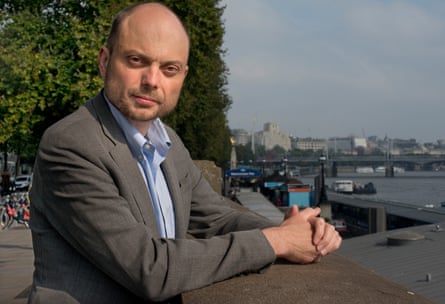 Political activist and former prisoner in Russia Vladimir Kara-Murza in London after the 2024 Ankara prisoner exchange. Photograph: Sophia Evans/The Observer
theguardian.com
Political activist and former prisoner in Russia Vladimir Kara-Murza in London after the 2024 Ankara prisoner exchange. Photograph: Sophia Evans/The Observer
theguardian.com
US prosecutors this week unsealed indictments alleging that five people working with Russian intelligence discussed recruiting US residents to kill a prominent Kremlin critic in Washington. The case, described by the US Department of Justice as part of a wider conspiracy to carry out attacks and murders internationally, is being read by Russian dissidents as a signal that a long-standing boundary may be eroding.
According to The Guardian, Roman Dobrokhotov, a Russian investigative journalist, said he now believes “the rules have changed in America” and that “nowhere is safe” for critics of the Kremlin. Dobrokhotov was previously named in a London trial as a target of a Russia-linked spy ring that discussed violent methods, including burning a victim alive or using toxins. The new US indictment alleges encrypted messages in Spanish and names an FSB officer, a former FSB colonel, and three men described as a Cuban expat dance instructor, a Venezuelan, and another suspect nicknamed “the Viking”. The alleged plan’s most striking feature is its setting: not London, Berlin or Istanbul, but the US capital.
For years, the assumption among many Russian opposition figures has been that the most dangerous ground lay in Europe, where travel is easy, émigré communities are dense, and Russia’s security services have a history of operating. The 1978 killing of Bulgarian dissident Georgi Markov in London—widely attributed to the KGB—remains a shorthand for how far Moscow has been willing to go on European streets. The Guardian reports that analysts and dissidents have spoken of an informal understanding that neither Washington nor Moscow would conduct killings on the other’s territory, a taboo that helped keep espionage from sliding into open-ended vendetta.
If US prosecutors are right, the operational problem is no longer the ability to reach a target but the willingness to accept the diplomatic cost of trying. Recruiting local residents, rather than flying in a team, lowers the logistical footprint and makes attribution messier in real time, even when indictments come later. For European security services, the logic is familiar: when the price of a failed plot is mostly paperwork and expulsions, risk-taking increases; when it is prison time, the pipeline shifts to cut-outs and deniable intermediaries.
The episode also lands in a Europe already spending political capital on deterrence while absorbing spillovers from the war in Ukraine, sanctions enforcement, and domestic polarisation over migration and security. A perceived expansion of Russian “active measures” to new terrain would not reduce the pressure on European capitals; it would reroute it, as dissidents look for safe havens and governments are forced to decide whether protection is a police task, an intelligence task, or an immigration task.
Dobrokhotov made his remarks at the Washington Dialogue conference on Russian affairs, held near the White House at the National Endowment for Democracy. The indictment, meanwhile, describes a target living openly in Washington.
The allegation is not that a murder succeeded, but that it was discussed as an option in a place that has long treated such plots as something that happens elsewhere.