
Ceuta reception centre hits capacity as migrants return to beaches
Port facility built for 1700 fills after mass transfer from shoreline camps, processing pace keeps the enclave in permanent overflow
Images
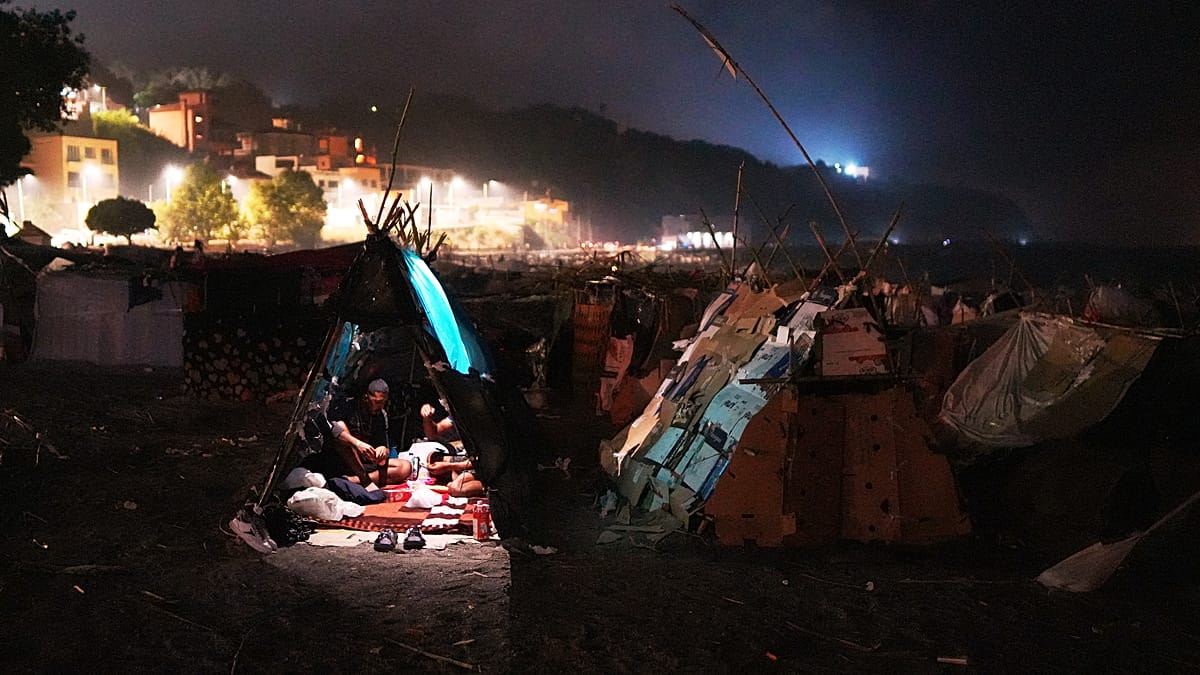 Thousands of migrants return to beaches in Ceuta as port camp fills up
euronews.com
Thousands of migrants return to beaches in Ceuta as port camp fills up
euronews.com
More than 2,000 migrants in Spain’s North African enclave of Ceuta were sent back to the beaches after a new temporary reception facility at the port hit capacity, according to Euronews. The site is designed for 1,700 people, but officials moved thousands from the Trampolín and Benítez beaches toward the port in a single push, only to find there was nowhere left to put them. Police struggled to keep order as migrants fought for places, and officers fired warning shots into the air, local authorities said.
The bottleneck is not at the fence but at the intake desk. Ceuta’s crisis began in late July when more than 70,000 people crossed from Morocco, a number that dwarfs the enclave’s ability to register, house, and transport arrivals. Government sources cited by Euronews said roughly 3,000 migrants remain on Ceuta’s streets, while makeshift tents and shacks still cover parts of the shoreline, delaying a planned clean-up operation. The port facility, presented as a solution, functions as a holding pen whose limits become visible the moment a new transfer begins.
Local officials describe the process as improvised and politically insulated. Kissy Chandiramani, a member of Ceuta’s autonomous government, said neither the city government nor port authorities were warned in advance about the transfer, calling it chaotic. She urged Spain to speed up return procedures and warned that, at the current pace, Ceuta could become a permanent reception complex rather than a transit point. Euronews reports that around 100 cases are being processed each day; Chandiramani said more resources could reduce the timeline to 15 days.
The numbers explain why small operational choices—where to place a camp, when to move a crowd, how many officers to deploy—turn into strategic signals. A reception centre that fills in hours tells would-be arrivals that the constraint is administrative rather than physical, and that staying put may be enough to force the next expansion. The state, meanwhile, pays twice: first for emergency infrastructure built under pressure, then for the political cost of admitting that the infrastructure did not change the underlying arithmetic.
On Friday, after thousands were escorted off the beaches toward the port, many were escorted back again because the camp was full.