
Pakistan signs expanded Mecca defence pact
Saudi Arabia and Turkey included as Yemen conflict escalates, public pledges harden into deployable obligations
Images
 Houthi rebel fighters in Sana’a, Yemen. This month the Houthis made unprecedented territorial gains and hit Saudi territory with missile strikes and drones. Photograph: Yahya Arhab/EPA
theguardian.com
Houthi rebel fighters in Sana’a, Yemen. This month the Houthis made unprecedented territorial gains and hit Saudi territory with missile strikes and drones. Photograph: Yahya Arhab/EPA
theguardian.com
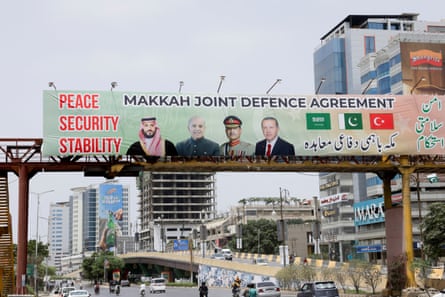 A billboard in Karachi, Pakistan, marks the signing of the Mecca joint defence agreement in August. Photograph: Akhtar Soomro/Reuters
theguardian.com
A billboard in Karachi, Pakistan, marks the signing of the Mecca joint defence agreement in August. Photograph: Akhtar Soomro/Reuters
theguardian.com
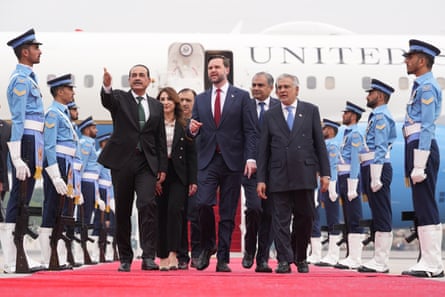 Gen Asim Munir welcomes the US vice-president, JD Vance, to Islamabad in April during diplomatic efforts to end the US-Israeli war with Iran. Photograph: Jacquelyn Martin/AP
theguardian.com
Gen Asim Munir welcomes the US vice-president, JD Vance, to Islamabad in April during diplomatic efforts to end the US-Israeli war with Iran. Photograph: Jacquelyn Martin/AP
theguardian.com
Pakistan deepens defence pledge to Saudi Arabia, Mecca pact expands to Turkey as Yemen war risk rises, Islamabad’s security priorities multiply while Riyadh holds the chequebook
Pakistan’s army chief, Gen Asim Munir, witnessed the signing of a defence pact with Saudi Arabia in Riyadh in September, according to The Guardian. The agreement ties Pakistan to Saudi territorial defence, alongside Saudi promises of billions of dollars in investments and loans, and commits Pakistan to train the Saudi military.
The timing matters because the region’s assumptions changed fast. The Guardian reports that analysts believed Pakistan signed when it expected US-Iran relations to improve and the risk of a wider Middle East conflict to stay low. By February, the US and Israel had bombed Iran, and Iran retaliated with missiles aimed at Gulf states including Saudi Arabia. That escalation fed back into Yemen: the fragile truce between Saudi Arabia and the Iran-aligned Houthi movement collapsed, and the Houthis launched missile and drone attacks on Saudi territory, prompting Saudi airstrikes on Yemen.
What looks like a bilateral arrangement is already being widened. In August, the pact was extended to include Turkey and was renamed the Mecca joint defence agreement, The Guardian writes. Its core clause is simple: an armed attack on any one of the three countries is treated as an attack on all. That language is designed to deter, but it also creates a mechanism for turning someone else’s battlefield into a contractual obligation.
Saudi Arabia has spent tens of billions of dollars on fighter jets and other military hardware, but still struggles to impose outcomes on the Houthis, who have proved resilient, The Guardian notes. Pakistan’s forces are trained for the country’s primary strategic problem — India — and that training is exactly what makes them attractive as frontline support in a Yemen campaign. Thousands of Pakistani troops are already deployed in Saudi Arabia for training duties, reducing the political and logistical friction of a larger deployment if Riyadh asks for it.
Inside Pakistan, the backdrop is less forgiving than the pact’s public language. The Guardian describes Pakistan as economically crippled and facing a surge in militancy, while also fighting a de facto war with the Taliban in Afghanistan. Government ministers and senior military figures have publicly confirmed an “unconditional” commitment, even as officials privately worry about being pulled into a conflict that would compete with domestic security needs and intensify sectarian and geopolitical pressures at home.
The pact’s selling point is stability through alignment; its operational reality is that the country with the cash can choose when the clause is tested.
Pakistan has promised to defend Saudi territory while its own forces are already stretched across multiple fronts.