
F-16 crashes in northern Michigan residential area
Pilot ejects as hazardous spill triggers one-mile evacuation, training mission risk shifts disruption to local authorities
Images
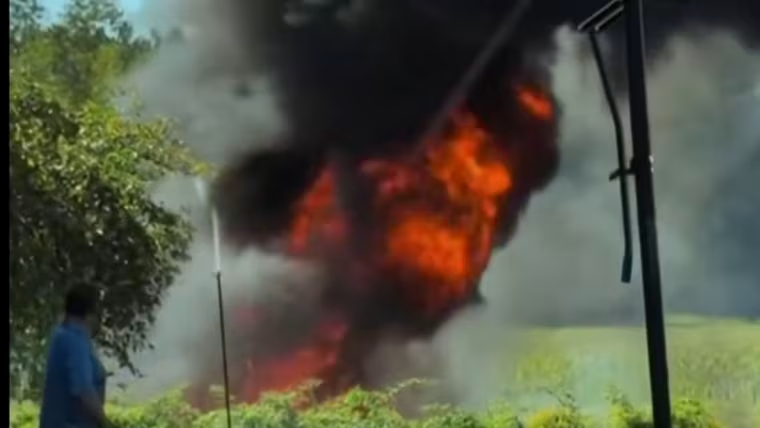 nbcnews.com
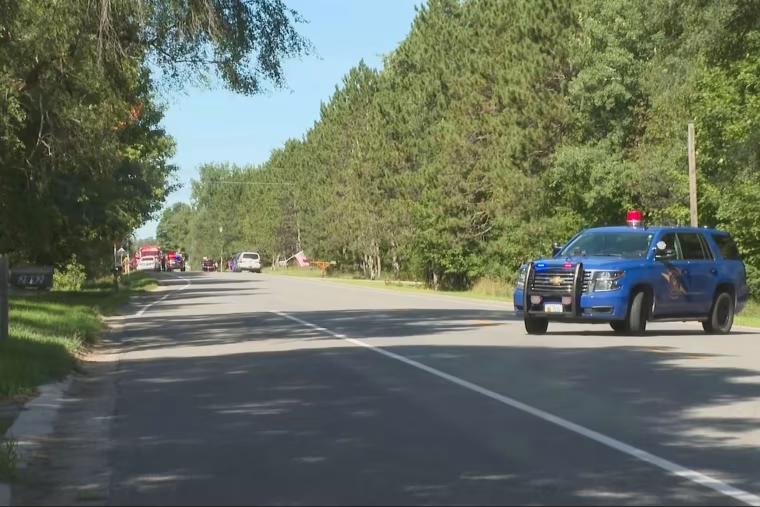 Rescue efforts after an F-16 fighter jet crashed in a rural area near Traverse City, Mich., on Thursday.WPBN
nbcnews.com
Rescue efforts after an F-16 fighter jet crashed in a rural area near Traverse City, Mich., on Thursday.WPBN
nbcnews.com
An F-16 fighter jet crashed into a residential area in northern Michigan on Thursday afternoon, prompting evacuations within a one-mile radius because of a hazardous chemical spill. The pilot ejected and was taken to a local hospital in stable condition, and authorities said there were no reports of civilian injuries, according to NBC News.
The aircraft was flying a routine training mission connected to the Air National Guard’s Combat Readiness Training Center in Alpena, Michigan, and was identified by state officials as an F-16 from the Texas Air National Guard. Air traffic control audio reviewed by NBC described a possible mayday call after the jet “may have taken a bird,” followed by reports of black smoke, a possible engine loss and an ejection. Witnesses described a loud boom, a parachute descending, and an explosion with dark smoke rising near homes; NBC said it verified social media video showing a smoke column close to a house.
The incident lands in a familiar gap between the military’s training requirements and the way risk is distributed when exercises take place near populated areas. A pilot can eject; nearby residents cannot, and local police and township officials become the public face of a federal incident they did not plan. The evacuation order—covering “all business and residential properties” within a mile—was lifted later that evening, but the disruption was immediate: roads blocked, people moved, and an investigation opened by the Texas Military Department.
Training flights are designed to rehearse emergencies in controlled conditions, yet the costs of an uncontrolled outcome are borne locally: potential property damage, temporary displacement, and the uncertainty of what exactly spilled and how it is being handled. NBC’s reporting did not specify the chemical involved, only that it was considered hazardous enough to trigger a wide perimeter. That leaves residents relying on official updates while the investigation proceeds, with the underlying technical cause—bird strike, mechanical failure, or something else—still undetermined.
The crash also illustrates how quickly accountability becomes procedural. The jet’s unit, Michigan’s military affairs department and state police all provided pieces of the picture, while the definitive explanation is deferred to an investigation whose timeline is not yet clear. In the meantime, the most concrete facts are the simplest: an aircraft came down in a neighborhood, and the emergency response treated the debris field as a chemical hazard.
By 9:44 p.m., authorities had lifted the one-mile evacuation order. The investigation remained open, and the residential streets where the smoke rose were back inside the perimeter of ordinary life.