
Researchers name new wild cat species in Bolivia
Genetic study splits South American tiger cats into five lineages, conservation lists still treat them as two declining species
Images
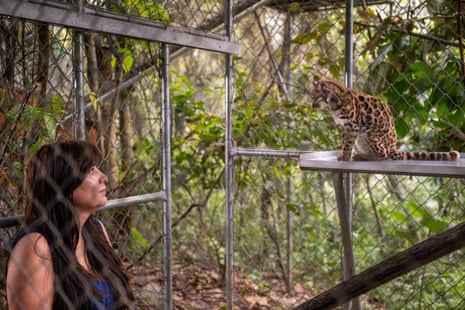 Paola Nogales Ascarrunz, a National Geographic explorer who led the research that identified the new species, observes the cat at an animal refuge in the Yungas region in Bolivia, on 1 September 2026. Photograph: Fernando Faciole/National Geographic/Reuters
theguardian.com
Paola Nogales Ascarrunz, a National Geographic explorer who led the research that identified the new species, observes the cat at an animal refuge in the Yungas region in Bolivia, on 1 September 2026. Photograph: Fernando Faciole/National Geographic/Reuters
theguardian.com
A wild cat living in Bolivia’s Yungas forest has been formally named as a new species, the first time in more than a century that a living cat species has been described, according to Reuters. Researchers say the animal—known locally as “Tilcayo”—belongs to the South American “tiger cat” group and was confirmed as distinct using genetic data. The team published the description in Current Biology and assigned the scientific name Leopardus tilcayo.
The finding reframes what had long been treated as a single, wide-ranging species that was hard to separate by appearance. Reuters reports that tiger cats are “cryptic” animals whose coats can look similar across regions, which has left taxonomy leaning on specimens and descriptions concentrated in some countries more than others. In the new study, researchers analysed DNA from dozens of tiger cats sampled across several South American countries, including museum specimens, and concluded the group actually contains multiple genetically distinct species. The Bolivian lineage had not previously been proposed as a separate species or subspecies, the report notes, even though its characteristics did not match earlier descriptions based largely on Brazilian cats.
The evidence base is still thin in practical terms. Reuters says current information on the Tilcayo cat comes from two live animals examined and a small number of camera-trap records. The cat is small—shorter and lighter than an average domestic cat, according to the measurements cited—and little is known about its behaviour beyond hints from indirect signs. Rodent remains found in scat samples suggest small mammals may be part of its diet, while camera traps indicate it could be more active at night. The researchers also described a new tiger cat subspecies in Peru’s Yungas, another reminder that the boundaries on conservation maps can lag behind what genetic sampling reveals in the field.
Those gaps matter because conservation status is assigned to names, not to lookalike populations. Reuters notes that the International Union for Conservation of Nature currently treats tiger cats as two vulnerable species with declining populations. If what was counted as one or two species is in fact several, each with its own range and pressures, then population estimates, threat assessments and protections may need rewriting. The Yungas itself is a mountainous belt of humid, cloud-covered forest—habitat that tends to be fragmented by roads and settlement because steep terrain concentrates development into narrow corridors.
For now, the Tilcayo cat’s scientific identity rests on genetic divergence and a handful of observations. One of the live individuals examined is a male living in a wildlife sanctuary after being kept by a local family, Reuters reports. A species can be named in a journal in a single week; building the basic biology needed to protect it can take years of fieldwork.