
Study links Nepal Tibet glacier-collapse floods to unusual warming
World Weather Attribution describes a rare avalanche driven by long-term temperature shifts, downstream roads and bridges fail before adaptation can catch up
Images
 Devighat Bazaar, a Nepalese town devastated by last month’s flash flooding. Photograph: Suryams Upreti/AAP
theguardian.com
Devighat Bazaar, a Nepalese town devastated by last month’s flash flooding. Photograph: Suryams Upreti/AAP
theguardian.com
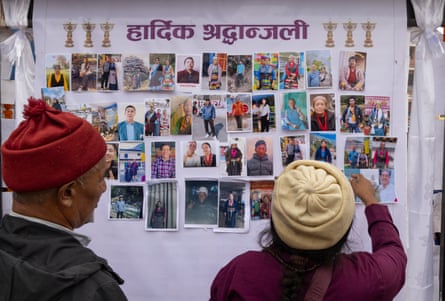 A impromptu memorial in Kathmandu commemorates some of the people killed in the flooding. Photograph: Narendra Shrestha/EPA
theguardian.com
A impromptu memorial in Kathmandu commemorates some of the people killed in the flooding. Photograph: Narendra Shrestha/EPA
theguardian.com
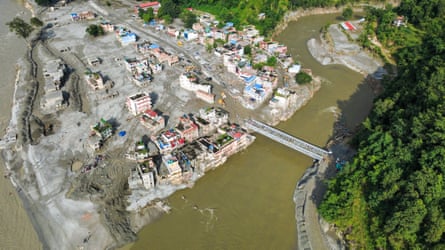 ‘Communities in Nepal are paying with their lives for a crisis driven by fossil fuel emissions thousands of miles away,’ said Dr Friederike Otto. Photograph: Suryams Upreti/AAP
theguardian.com
‘Communities in Nepal are paying with their lives for a crisis driven by fossil fuel emissions thousands of miles away,’ said Dr Friederike Otto. Photograph: Suryams Upreti/AAP
theguardian.com
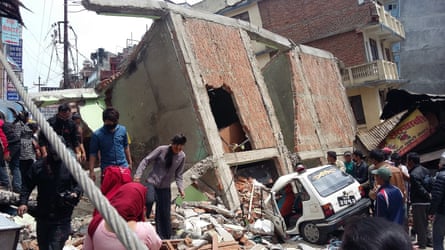 A major earthquake in Nepal in 2015 may also have contributed to the glacier’s collapse. Photograph: Ishwar Rauniyar/The Guardian
theguardian.com
A major earthquake in Nepal in 2015 may also have contributed to the glacier’s collapse. Photograph: Ishwar Rauniyar/The Guardian
theguardian.com
A glacier collapse that triggered catastrophic floods in Nepal and Tibet in August 2023 was likely made more probable by unusually warm conditions linked to long-term atmospheric heating, according to a first scientific study cited by The Guardian.
The study, by researchers working with the World Weather Attribution initiative, examines a glacier that fell from Langtang Lirung mountain on 26 August 2023. The glacier, described as roughly 200,000 square metres, dropped about 1,400 metres to the valley floor and the impact registered as an earthquake. Researchers estimate the collapse sent an avalanche of 110 million cubic metres of snow and ice into the valley, setting off flash floods that raced downstream at speeds exceeding 110 mph.
The human toll described in the report is vast: more than 1,300 people were killed and more than 5,000 remain missing. Roads, bridges and settlements were swept away, leaving survivors cut off as debris-laden water, ice, rock and sediment surged through valleys that also serve as transport corridors and lifelines for downstream communities.
The research focuses less on a single storm than on the background conditions that made a rare event more plausible. According to the study, the region has warmed by about 2°C since pre-industrial times, with July and August 2023 the warmest on record locally. In the days before the collapse, temperatures reportedly reached 5°C above the 30-year average. The freezing threshold in the Himalayas has risen by about 100 metres per decade since the 1980s, a shift that lengthens melt seasons and pushes thaw higher into terrain that previously remained more reliably frozen.
That matters because high mountain hazards increasingly behave like supply chains: what happens at altitude arrives downstream as a sudden, physical shock to towns, hydropower, roads and bridges. The Guardian describes the flood as a “freezing flood” caused by liquefaction of ice upon impact, a mechanism that turns a collapse into fast-moving water and debris rather than a slower, containable slide. When transport links and power infrastructure sit in narrow valleys, a single failure can strand whole districts and make rescue and recovery depend on whatever equipment and access remains.
The study also highlights a practical limit to adaptation. Better early warning, land-use planning and stronger infrastructure can reduce harm, but they cannot fully offset hazards whose underlying frequency and magnitude change as temperatures rise. In the World Weather Attribution framing, the upstream driver is decades of greenhouse gas pollution, meaning the risk profile is being altered far from the valleys where the damage is ultimately paid.
The collapse began with a slab of ice high on Langtang Lirung. The costs, the study suggests, are still being counted in missing-person lists and broken bridges downstream.