
Indonesian wildfires near Gunung Palung threaten orangutan research stations
Cabang Panti data set faces disruption after decades of fieldwork, peat fires turn land clearing into long smouldering risk
Images
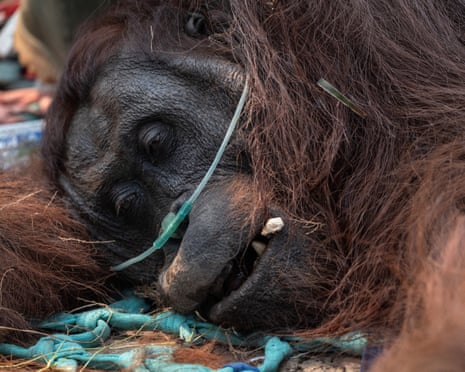 An orangutan named Sampurna receives emergency treatment in the village of Kuala Satong after being rescued from wildfires in Indonesia’s West Kalimantan province. Photograph: Willy Kurniawan/Reuters
theguardian.com
An orangutan named Sampurna receives emergency treatment in the village of Kuala Satong after being rescued from wildfires in Indonesia’s West Kalimantan province. Photograph: Willy Kurniawan/Reuters
theguardian.com
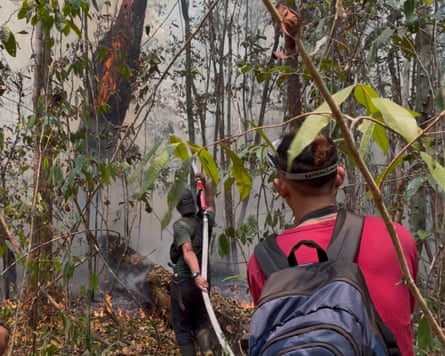 Field assistants fight fires near the Rangkong research station. Photograph: Jessica Laman
theguardian.com
Field assistants fight fires near the Rangkong research station. Photograph: Jessica Laman
theguardian.com
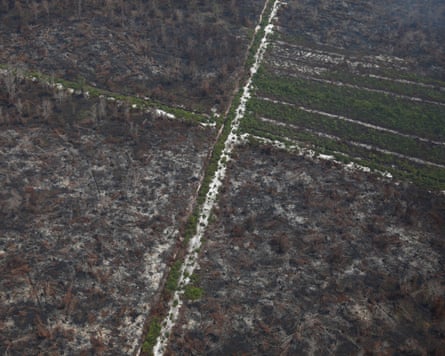 Burnt forest near Palangka Raya, in Central Kalimantan province this week. Photograph: Willy Kurniawan/Reuters
theguardian.com
Burnt forest near Palangka Raya, in Central Kalimantan province this week. Photograph: Willy Kurniawan/Reuters
theguardian.com
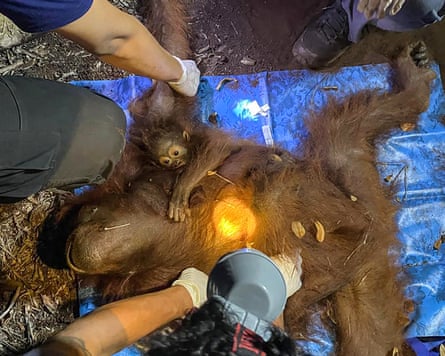 Rescue workers prepare to transport a mother and baby orangutan named Raya and Rayu who were rescued from wildfires in East Kotawaringin, Central Kalimantan province. Photograph: Reina/AFP/Getty Images
theguardian.com
Rescue workers prepare to transport a mother and baby orangutan named Raya and Rayu who were rescued from wildfires in East Kotawaringin, Central Kalimantan province. Photograph: Reina/AFP/Getty Images
theguardian.com
Wildfires in Indonesia have burned to within 200 metres of the Rangkong research station in Gunung Palung national park in West Kalimantan, according to The Guardian. Field teams say the blaze is moving through peatland and could reach the main Cabang Panti orangutan research station within about 20 days without larger firebreaks or outside help. An orangutan named Sampurna was treated in the village of Kuala Satong after being rescued from the fires.
The immediate threat is not only to animals but to a rare kind of capital that cannot be rebuilt quickly: continuous field data gathered over decades. Researchers at Cabang Panti have tracked wild Bornean orangutans for more than 30 years, building life histories that underpin basic facts about the species, including its unusually long reproductive cycle. When a research station is forced to evacuate, the loss is not just a destroyed camp; it is broken time series, interrupted identification of individual animals, and a gap in observations that future studies cannot retroactively fill.
The Guardian reports that many of the fires are intentionally set for land clearing, an annual practice that becomes more destructive in unusually hot and dry years. This season’s conditions have been sharpened by a strong El Niño, with months of little to no rainfall in parts of West Kalimantan. In peat swamps, fire does not behave like a normal forest blaze: it can smoulder underground for months, re-emerging long after surface flames appear controlled. That dynamic turns firefighting into a water-management problem, and it punishes areas where drainage and land conversion have lowered the water table.
Around the stations, a team of more than 40 people—field assistants, staff and local villagers—has built a firebreak and rigged an improvised sprinkler system from a punctured hose to keep peat saturated. The work is labour-intensive and local by necessity, but it also illustrates a recurring pattern in conservation: the people closest to the damage are left to improvise while the larger economic drivers of land clearing remain intact. Caitlin O’Connell of the Gunung Palung Orangutan Conservation Program told The Guardian the situation has surpassed any local organisation’s capacity.
Gunung Palung is described by researchers as one of the few remaining ecologically intact tracts of lowland tropical rainforest in Borneo, with more than 2,500 Bornean orangutans thought to live in the park. If the fires breach the research area, Indonesia does not just risk another headline about endangered wildlife; it risks losing a living laboratory that has been measuring how a tropical ecosystem responds—year by year—to heat, drought and human pressure.
At Rangkong, the defence is a wet ring of peat and a hose that sprays through holes punched by hand. The future of a 32-year dataset is being negotiated in buckets and firebreaks.