
NATO jets shoot down drone over Lithuania
Danish helicopter targeted with flares from Russian warship in Baltic, border air defence becomes a standing cost of the Ukraine war
Images
 Lithuanian soldiers secure the area near Pratkunai village, Kaisiadorys district, on Tuesday, where Italian fighter jets shot down a drone early on Tuesday. Photograph: Mindaugas Kulbis/AP
theguardian.com
Lithuanian soldiers secure the area near Pratkunai village, Kaisiadorys district, on Tuesday, where Italian fighter jets shot down a drone early on Tuesday. Photograph: Mindaugas Kulbis/AP
theguardian.com
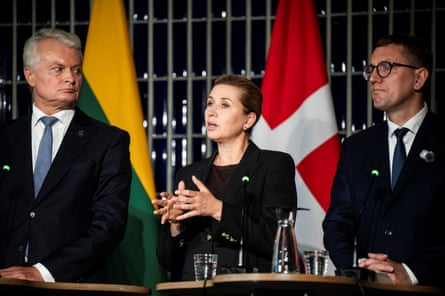 From left: Gitanas Nausėda, president of Lithuania; Mette Frederiksen, the Danish prime minister, and Kristen Michal, prime minister of Estonia, at the European Arctic summit in Rovaniemi, Finland on Monday. Photograph: Jouni Porsanger/Reuters
theguardian.com
From left: Gitanas Nausėda, president of Lithuania; Mette Frederiksen, the Danish prime minister, and Kristen Michal, prime minister of Estonia, at the European Arctic summit in Rovaniemi, Finland on Monday. Photograph: Jouni Porsanger/Reuters
theguardian.com
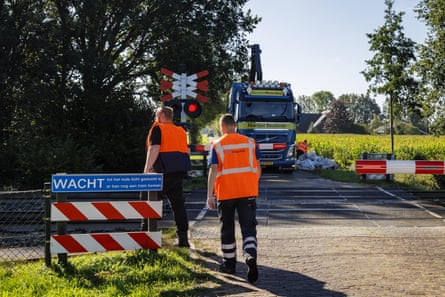 Contractors work along the railway line in Holten, the Netherlands, after trains were halted. Photograph: Vincent Jannink/EPA
theguardian.com
Contractors work along the railway line in Holten, the Netherlands, after trains were halted. Photograph: Vincent Jannink/EPA
theguardian.com
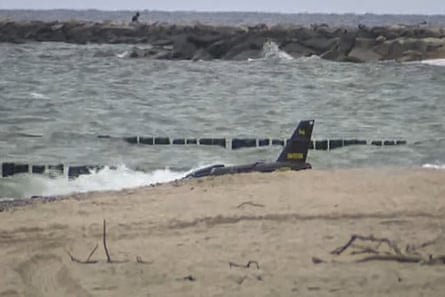 TV picture of a suspected Russian drone lying on a Baltic Sea beach after it was retrieved by the Polish military on Monday. Photograph: AFPTV/TVN/AFP/Getty Images
theguardian.com
TV picture of a suspected Russian drone lying on a Baltic Sea beach after it was retrieved by the Polish military on Monday. Photograph: AFPTV/TVN/AFP/Getty Images
theguardian.com
**NATO jets shoot down drone over Lithuania, flares fired at Danish helicopter in Baltic incident, cheap unmanned probes force expensive responses across Europe**
An Italian NATO fighter jet shot down a drone carrying an explosive device after it entered Lithuanian airspace early Tuesday, according to The Guardian. The drone fell near the village of Pratkūnai, west of Vilnius and close to the Kaunas reservoir, and Lithuania’s president Gitanas Nausėda said it most likely came from Belarus. The incident came a day after Denmark said a Russian warship fired two emergency flares at a Danish military helicopter during a routine photographic operation in international waters off southern Denmark.
Taken together, the episodes show how the Ukraine war’s airborne spillover is no longer confined to Ukrainian skies. A single unmanned aircraft drifting across a border now triggers a chain reaction: alerts, scrambles, shootdowns, debris searches, diplomatic summons, and public messaging designed to reassure voters that the state still controls its airspace. The Guardian reports that Poland scrambled fighters amid Russian jet-powered unmanned aerial vehicle activity linked to strikes on Ukrainian territory, and that Polish forces also retrieved a suspected Russian drone found adrift in Polish waters. In Germany, authorities were still searching for debris from a drone believed to have crashed near Lake Steinhude in the Hanover region, with the suspected impact site reported to be close to a Bundeswehr airbase.
The costs distribute unevenly. The drone itself is the cheap part; the expensive part is the air policing architecture that must treat each incursion as potentially real, potentially armed, and potentially escalatory. Even when nothing detonates, the response consumes flight hours, readiness cycles and investigative manpower, while the originating side can deny intent, blame navigation, or claim provocation. Denmark’s armed forces said no warning or radio contact was given before flares were fired, and Denmark’s foreign minister summoned Russia’s ambassador. Russia’s ambassador, for his part, accused the Danish helicopter of dangerous manoeuvres—an exchange that keeps the immediate facts contested while the operational burden stays with the countries doing the monitoring.
European officials are already framing the pattern as coercion rather than accident. The EU described the Russian behaviour as “reckless and dangerous”, and European Commission president Ursula von der Leyen said the incidents formed part of a broader pattern of aggression and provocation, according to The Guardian. But the practical question for frontline states is not rhetoric; it is throughput: how many alerts can air forces handle, how quickly can debris be identified, and how many ambiguous events can be managed before routine becomes normal.
On Tuesday, Lithuanian soldiers cordoned off a field near Pratkūnai to secure the drone’s crash site. The drone had already done its work by then: it forced a NATO intercept and a public demonstration of vigilance over a few metres of airspace.