
US Supreme Court blocks Trump mail ballot restrictions
Emergency order cites low odds of success and late timing, election machinery stays on old rails for midterms
Images
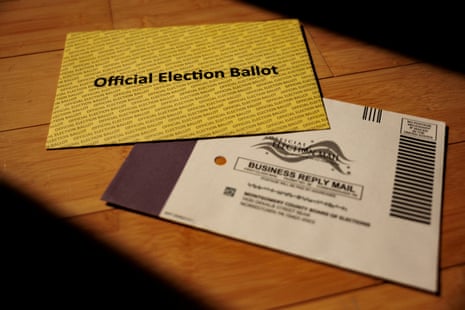 A mail-in ballot during the Pennsylvania primary election in Philadelphia on 19 May 2026. Photograph: Hannah Beier/Reuters
theguardian.com
A mail-in ballot during the Pennsylvania primary election in Philadelphia on 19 May 2026. Photograph: Hannah Beier/Reuters
theguardian.com
A one-paragraph Supreme Court order has blocked the Trump administration’s attempt to tighten mail voting rules weeks before November’s midterm elections. According to The Guardian, the government asked the court to let it restrict the distribution of mail ballots, but the justices said the administration was unlikely to succeed and that emergency relief was disfavored.
The dispute turned on timing as much as authority. The lawsuit was brought by voting-rights groups alongside 23 states and the District of Columbia, arguing that the president has no constitutional power to direct election administration. The administration’s plan, The Guardian reports, would have required the US Postal Service to refrain from delivering ballots to registered voters deemed ineligible based on Department of Homeland Security and other federal records—an approach that would have forced states to rework long-established processes on the eve of an election.
Justice Brett Kavanaugh, concurring, wrote that the government had a “fair prospect” of success, but still declined to allow a late-stage overhaul, calling it potentially “arbitrary and capricious” so close to election day. Justice Samuel Alito dissented, joined by Justice Clarence Thomas, and argued that the states should not benefit from what he described as delay. The practical result is that states may continue mailing ballots as they have for years, in an election system where, The Guardian notes, nearly one-third of Americans vote by mail.
The case illustrates how election administration has become a permanent arena for national power struggles, even though the work itself is operational: printing, verifying, delivering, and counting ballots on fixed calendars with fixed staffing. Election officials told the court it was impossible to implement a “complete overhaul” of mail-ballot procedures on short notice, and some states had already started sending ballots under existing rules, including Alabama, North Carolina, and Wisconsin.
Civil-rights groups framed the administration’s move as an attempt to disrupt voting at the last minute. Kristen Clarke, NAACP general counsel and a former head of the Justice Department’s civil rights division, called it an “11th-hour” effort to hijack mail voting, while Democratic Representative Robert Garcia said Trump had tried to interfere with elections. The administration, for its part, sought to tie ballot delivery to federal eligibility records—an attractive concept for a White House that wants a single lever it can pull nationwide, even when the costs of implementation land on local election offices.
The order leaves the executive order issued on 31 March without the emergency boost it needed to take effect in time. Ten days after the administration issued its final rule, the Supreme Court declined to let it reshape how ballots reach voters.