
Weigh-and-pay shops spread in Johannesburg’s Alexandra
Gcwalisa sells staples by the spoon to counter South Africa’s poverty tax, container retail doubles as ad hoc power and service delivery
Images
 One of the shops runs by Gcwalisa – which means ‘fill up’ in isiZulu – in Johannesburg’s Alexandra township. Photograph: Julie Bourdin
theguardian.com
One of the shops runs by Gcwalisa – which means ‘fill up’ in isiZulu – in Johannesburg’s Alexandra township. Photograph: Julie Bourdin
theguardian.com
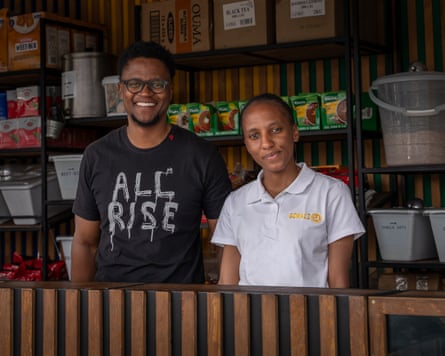 Gcwalisa’s founder, Miles Kubheka (left), with head of operations Josephine Katumba in one of their container shops. Photograph: Julie Bourdin
theguardian.com
Gcwalisa’s founder, Miles Kubheka (left), with head of operations Josephine Katumba in one of their container shops. Photograph: Julie Bourdin
theguardian.com
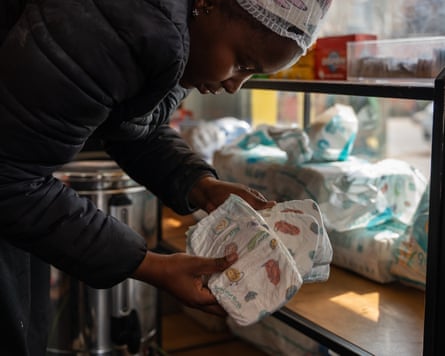 A shopkeeper, Oarona Maleka, sorts through nappies – available for sale individually – at a Gcwalisa shop in Alexandra. Photograph: Julie Bourdin
theguardian.com
A shopkeeper, Oarona Maleka, sorts through nappies – available for sale individually – at a Gcwalisa shop in Alexandra. Photograph: Julie Bourdin
theguardian.com
In Johannesburg’s Alexandra township, a social enterprise called Gcwalisa sells sugar, grains and household essentials by weight from shipping-container shops, letting customers buy spoonfuls rather than bags. The Guardian reports that the model is meant to blunt the “poverty tax” that hits low-income households who cannot afford bulk purchases and end up paying more per unit for small pre-packaged quantities. The company, launched in 2022 by Miles Kubheka, now operates six container shops in Alexandra.
The business works because it monetises a constraint that supermarkets treat as a rounding error: cashflow volatility. A two-kilogram bag of sugar may be affordable on paper, but for households balancing transport, school costs and intermittent income, the binding limit is what is left in the pocket today. The Guardian describes customers buying tiny amounts of staples and detergents, and notes that the product range has expanded to painkillers, period pads and nappies—items where running out creates immediate costs. When a grandmother asks to buy disposable nappies individually because she reuses them, the unit economics are no longer a lifestyle choice; they are a coping mechanism.
South Africa produces enough food to feed its population, yet hunger remains widespread. The Guardian cites a 2024 national survey finding that nearly two-thirds of households are affected by food insecurity, alongside high rates of child stunting. At the same time, obesity and diabetes are widespread and have overtaken HIV and tuberculosis as leading causes of natural death, a pattern consistent with diets built around cheap calories rather than accessible nutrition. In that setting, selling in micro-quantities is not just about price; it is about smoothing consumption when the state safety net is partial and the private retail system is optimised for shoppers who can buy ahead.
Gcwalisa also ends up substituting for municipal reliability. During power cuts that The Guardian says lasted up to 12 hours a day in 2023, the enterprise installed solar panels on some containers, supplying electricity to nearby homes and a local school and even powering traffic lights at a junction into Alexandra. That turns a retail footprint into a local infrastructure node, but it also underlines the inversion: a shopkeeper becomes the party that can keep the lights on because the formal provider cannot.
Gcwalisa encourages customers to bring refillable containers, cutting packaging waste, but the immediate value proposition is simpler: the ability to buy exactly what the day’s cash allows. In Alexandra, the margin is measured in teaspoons, and the grid backup is mounted on a shipping container roof.