
China rejects calls to slow AI development
Foreign ministry calls U.S. warnings fearmongering ahead of Trump Xi summit, safety language tracks chip controls and copying claims
Images
 WAIC World Artificial Intelligent Coference
nbcnews.com
WAIC World Artificial Intelligent Coference
nbcnews.com
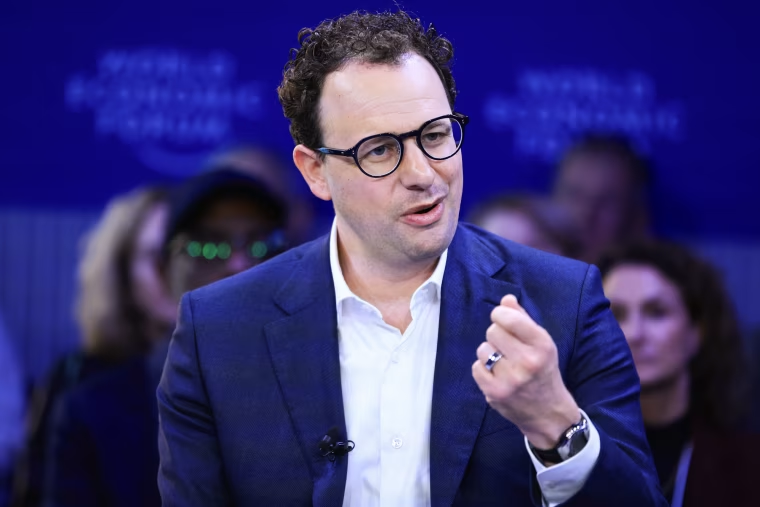 Anthropic CEO Dario Amodei published an essay on his website over the weekend entitled "We Must Pace The Frontier." Krisztian Bocsi / Bloomberg via Getty Images file
nbcnews.com
Anthropic CEO Dario Amodei published an essay on his website over the weekend entitled "We Must Pace The Frontier." Krisztian Bocsi / Bloomberg via Getty Images file
nbcnews.com
 OpenAI CEO Sam Altman said his company would adopt one of Amodei’s proposed safeguards.Kyle Grillot / Bloomberg / Getty Images
nbcnews.com
OpenAI CEO Sam Altman said his company would adopt one of Amodei’s proposed safeguards.Kyle Grillot / Bloomberg / Getty Images
nbcnews.com
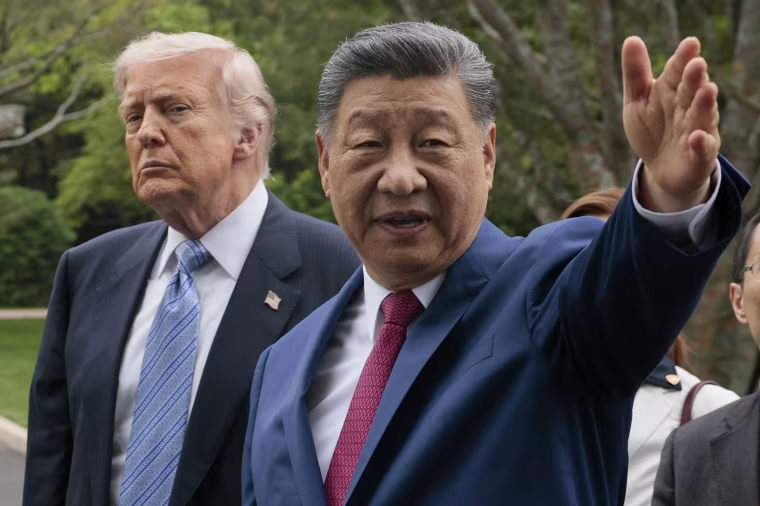 President Donald Trump with Chinese President Xi Jinping in Beijing in May. China says the warnings are aimed at slowing its progress.Evan Vucci / Pool /AFP via Getty Images
nbcnews.com
President Donald Trump with Chinese President Xi Jinping in Beijing in May. China says the warnings are aimed at slowing its progress.Evan Vucci / Pool /AFP via Getty Images
nbcnews.com
 How exactly could AI cause widespread danger?
nbcnews.com
How exactly could AI cause widespread danger?
nbcnews.com
 Image description
the-decoder.com
Image description
the-decoder.com
China rejects calls to slow AI development, foreign ministry labels U.S. warnings fearmongering ahead of Trump Xi summit, safety rhetoric collides with chip controls and model copying claims
China’s foreign ministry on Monday dismissed U.S. calls to slow the pace of artificial intelligence development, describing the warnings as “fearmongering” and part of a Cold War-style approach to technology competition. The pushback comes as Washington and Beijing prepare for a planned meeting between President Donald Trump and China’s leader Xi Jinping on September 24, according to NBC News.
The immediate argument is about safety, but the practical dispute is about who gets to set the rules for the next general-purpose technology. Anthropic chief executive Dario Amodei published an essay urging companies to deliberately slow AI model improvements, warning that a Chinese lead would be dangerous and calling for tighter U.S. restrictions on sales of key technology to China, NBC reports. Beijing’s response, carried in comments from foreign ministry spokesperson Guo Jiakun, framed U.S. rhetoric as an attempt to disrupt “global AI governance” through confrontation and “malicious competition.” State-run Global Times went further, accusing U.S. AI leaders of trying to freeze an American advantage by turning safety into a barrier for rivals.
That framing aligns with the way export controls and security claims have been used in the wider U.S.-China tech conflict. The Decoder, citing reporting from the Financial Times and Bloomberg, notes that Amodei has also urged action against “distillation,” the practice of using outputs from leading models to train competitors. U.S. agencies have recently accused Chinese AI companies of systematically copying cutting-edge American systems, an allegation Beijing rejects, according to NBC. When the dispute is defined as theft and national security, the policy tool becomes denial of chips, cloud capacity, and know-how; when it is defined as safety, the tool becomes a call for coordinated restraint that is easy to endorse in principle and hard to verify in practice.
China’s own security officials are not arguing for restraint so much as for control plus acceleration. NBC reports that China’s state security minister Chen Yixin has called for building systems to prevent and control AI security risks while also speeding up the establishment of an AI security framework and engaging in international cooperation. The Decoder describes Chen as urging faster infrastructure buildout and tighter supervision rather than a slowdown. In both capitals, the public language is about risk management; the operational priority is keeping domestic labs and supply chains moving.
Trump has publicly rebuffed industry warnings about AI catastrophe and said his focus is on beating China, NBC reports. That leaves U.S. AI firms facing a narrow path: they can ask for government help to coordinate safety measures internationally, as OpenAI’s Sam Altman has suggested, while operating in a race that neither government appears willing to pause.
The next test of what either side means by “governance” arrives on September 24, when the two leaders are expected to meet in Washington while their officials argue over whether slowing down is safety policy or industrial policy.