
Simon Tisdall: Putin drags out Ukraine war as winter nears
Nato debate returns as US commitment wobbles, missile-and-drone routine turns civilians into the front line
Images
 A rescue worker puts out a fire in a building destroyed after a Russian missile attack in Kyiv, 8 September 2026. Photograph: Alex Babenko/AP
theguardian.com
A rescue worker puts out a fire in a building destroyed after a Russian missile attack in Kyiv, 8 September 2026. Photograph: Alex Babenko/AP
theguardian.com
 Simon Tisdall
theguardian.com
Simon Tisdall
theguardian.com
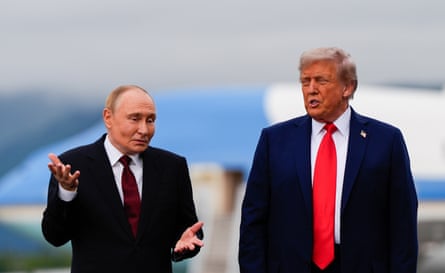 Vladimir Putin and Donald Trump meet at the Elmendorf-Richardson military facility in Alaska, 15 August 2025. Photograph: Julia Demaree Nikhinson/AP
theguardian.com
Vladimir Putin and Donald Trump meet at the Elmendorf-Richardson military facility in Alaska, 15 August 2025. Photograph: Julia Demaree Nikhinson/AP
theguardian.com
A Russian missile strike destroyed a building in Kyiv on 8 September, according to the Guardian’s Simon Tisdall, as Russia’s war in Ukraine enters its fifth year and daily attacks on cities and infrastructure continue. Tisdall argues that Moscow is escalating pressure on civilians through ballistic missiles and jet-and-drone strikes aimed at logistics facilities and basic services, with winter approaching and renewed concern about attacks on water supplies and the power grid.
The column describes a campaign that treats electricity and heating as targets rather than byproducts of fighting, pushing shortages of food and essentials and driving up civilian casualties. Tisdall frames this as a bet by Vladimir Putin that endurance and attrition can achieve what battlefield manoeuvre has not: breaking Ukrainian will, or at least forcing a settlement on Russian terms. The piece also points to the diplomatic theatre around potential talks, including recent visits by Donald Trump’s envoys Jared Kushner and Steve Witkoff to Moscow and Kyiv, which Tisdall says sustains Kremlin hopes that time is on Russia’s side.
On the other side, the column portrays NATO’s restraint as a policy choice shaped by uncertainty about Washington. Tisdall writes that US support surged in 2022 under Joe Biden but later thinned, and that Trump has sent mixed signals by pausing weapons deliveries and backtracking on steps related to Patriot interceptors, leaving Europe unable to fill the air-defence gap quickly. That gap matters most in the places where the war is no longer an abstract line on a map: cities facing repeated strikes, warehouses and distribution hubs that keep basic supplies moving, and the grid that turns fuel into heat.
Public opinion, as presented in the piece, cuts against the logic of indefinite war. Tisdall cites polling suggesting roughly 60% of Ukrainians oppose ceding the Donbas, while a similar share support a ceasefire that freezes current positions if accompanied by western security guarantees. He also writes that most Russians want the war to stop, even as Putin presses on. Kyiv’s financial strain is another constraint: the column notes difficulties despite a large EU loan, underscoring how continued resistance depends not only on morale and manpower but on steady external financing and air-defence resupply.
The argument returns repeatedly to the same operational fact: Russia can keep launching strikes every day without having to win decisively on the ground, while Ukraine has to defend everywhere every night. As winter approaches, the difference between a functioning transformer station and a burning one becomes a strategic variable.
Tisdall’s account begins with a single building in Kyiv reduced to rubble. It ends with the prospect that the next targets are the pipes and wires that make a city livable.