
Rosalind Franklin Institute unveils Curie microscope
UK lab images living tissue at roughly 20-nanometre scale, sharper pictures arrive long before sharper treatments
Images
 Dr Karina Pombo-Garcia peers into a new microscope that could unlock new knowledge about bowel conditions like Crohn’s. Photograph: Adam Gasson/Rosalind Franklin Institute
theguardian.com
Dr Karina Pombo-Garcia peers into a new microscope that could unlock new knowledge about bowel conditions like Crohn’s. Photograph: Adam Gasson/Rosalind Franklin Institute
theguardian.com
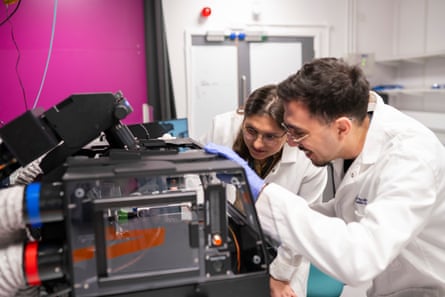 Dr Pombo-Garcia and Dimitrios Ioannidis, a PhD student, with the new kit, which allows them to see details down to just 20nm in size. Photograph: Adam Gasson/Rosalind Franklin Institute
theguardian.com
Dr Pombo-Garcia and Dimitrios Ioannidis, a PhD student, with the new kit, which allows them to see details down to just 20nm in size. Photograph: Adam Gasson/Rosalind Franklin Institute
theguardian.com
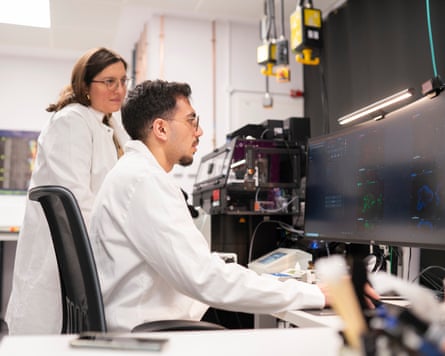 PhD student Dimitrios Ioannidis is using the microscope to understand how cells that line our internal organs create protective barriers. Photograph: Adam Gasson/Rosalind Franklin Institute
theguardian.com
PhD student Dimitrios Ioannidis is using the microscope to understand how cells that line our internal organs create protective barriers. Photograph: Adam Gasson/Rosalind Franklin Institute
theguardian.com
A new microscope at the Rosalind Franklin Institute in Oxfordshire can resolve structures down to about 20 nanometres—roughly ten times finer than conventional light microscopy—and researchers think it could change what they can see inside the tissues affected by inflammatory bowel disease. The instrument, nicknamed “Curie”, is being used at the Harwell Science and Innovation Campus to image living cells and lab-grown “mini-organs” in conditions close to body temperature, according to The Guardian.
The promise is not a single dramatic photograph but a shift in what becomes measurable. In Crohn’s disease and ulcerative colitis—the two main forms of inflammatory bowel disease—patients often cycle through drugs that suppress inflammation without fully answering why the immune system and the gut’s protective lining fail in the first place. The Guardian notes that more than half a million people in the UK live with inflammatory bowel disease, and the conditions are commonly diagnosed between ages 15 and 40, when symptoms collide with education, early careers and family formation. That creates a long tail of costs: repeated clinic visits, time off work, and escalating therapies that can be effective for some people while leaving others with persistent symptoms.
Curie is built around stimulated emission depletion (STED) microscopy, a two-laser method that won the 2014 Nobel prize in physics. Fluorescent tags mark features inside cells; one laser excites them, while a second, doughnut-shaped beam switches off fluorescence around the edges so that only a smaller central spot is detected. In practice, that allows researchers to distinguish structures that would blur together in standard fluorescence microscopes. The system also uses deformable mirrors to correct distortions introduced by thicker samples, letting scientists image deeper into tissue and organoid models without losing clarity.
That matters because much of the gut’s function depends on microscopic architecture: how epithelial cells seal together, how mucus layers form, and how immune cells interact with the barrier. The Guardian reports that PhD student Dimitrios Ioannidis is using the microscope to study how cells lining internal organs create protective barriers—work aimed at mechanisms rather than symptoms. If those mechanisms can be mapped with higher precision, it could narrow the search space for drug targets and help explain why treatments that broadly dampen inflammation sometimes miss the specific failure mode in a given patient.
For now, the breakthrough is an instrument and a capability, not a new therapy. The Rosalind Franklin Institute says Curie is the only microscope of its kind in the UK, concentrating a scarce research tool in one facility even as the burden of inflammatory bowel disease remains widely distributed.