
Indonesian ferry capsizes in Java Sea
Officials report at least six dead and about 130 missing on Surabaya to Banjarmasin route, relatives scan whiteboard lists as rescue capacity meets archipelago reality
Images
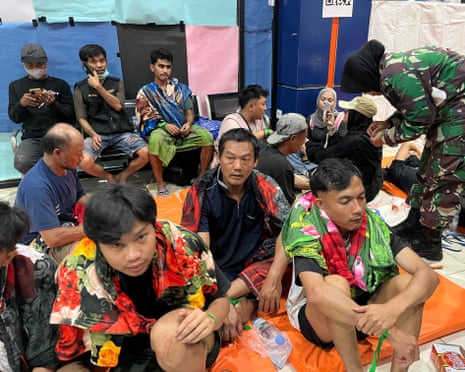 Survivors recover at the port in Banjarmasin, Indonesia. Photograph: WIWIN/EPA
theguardian.com
Survivors recover at the port in Banjarmasin, Indonesia. Photograph: WIWIN/EPA
theguardian.com
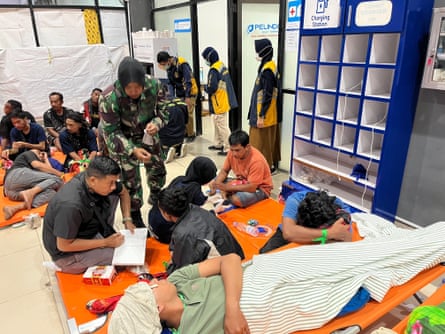 Survivors of the ferry accident rest after arriving at a port in Banjarmasin. Photograph: WIWIN/EPA
theguardian.com
Survivors of the ferry accident rest after arriving at a port in Banjarmasin. Photograph: WIWIN/EPA
theguardian.com
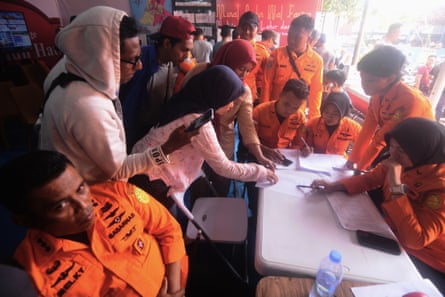 People look for the names of family members on a passenger list at the rescue command centre in Banjarmasin on Sunday. Photograph: Iman Satria/AP
theguardian.com
People look for the names of family members on a passenger list at the rescue command centre in Banjarmasin on Sunday. Photograph: Iman Satria/AP
theguardian.com
At least six people have died and about 130 were reported missing after an Indonesian ferry capsized in the Java Sea, according to The Guardian. The vessel, Virgo Transport 8, was sailing from Surabaya in East Java to Banjarmasin in South Kalimantan when contact was lost early on Sunday, with officials later saying the ferry had capsized but not sunk.
Indonesia’s geography makes ferry travel less a niche mode of transport than basic connective tissue: more than 17,000 islands, long overwater distances, and a population that still depends on roll-on/roll-off ships for routine movement of people and goods. That dependence also turns each accident into a stress test of the state’s ability to enforce standards at scale. The Guardian notes that safety rules are “not always rigorously enforced,” a polite description for a system where manifests, loading limits, and seaworthiness checks can become negotiable when demand is high and enforcement is thin. In this case, rescuers faced waves reported as reaching 2.5 metres, and a helicopter was used to locate the vessel—useful for spotting a hull, less useful for retrieving large numbers of people from rough water.
The human side of these incidents is often reduced to rolling numbers—dead, missing, rescued—until it reappears in small administrative scenes. The Guardian describes relatives scanning a whiteboard at Banjarmasin port listing names of those brought in, and a woman searching for news of her brother. Those details matter because they show what “response” looks like on the ground: improvised information management at a dock, while the true accounting of who boarded depends on records that may not capture everyone who travelled.
The ferry disaster also lands in a pattern of recurring maritime emergencies. The Guardian points to other recent incidents, including a ferry fire in the Lombok strait that killed one person, left five missing and saw more than 200 rescued, and a separate sinking near Selayar island. Each event is treated as a discrete tragedy, but the common thread is that an archipelago runs on boats, and the cost of weak compliance is paid in mass-casualty bursts when weather, loading, and maintenance problems collide.
By Sunday afternoon, officials said the capsized ferry was still afloat. The missing list, meanwhile, was still being read off a board at the port.