
Swedish wind turbine parts get second life as housing and building materials
Vattenfall tests reuse options for composite blades that resist standard recycling, landfill bans force owners to find markets not just methods
Images
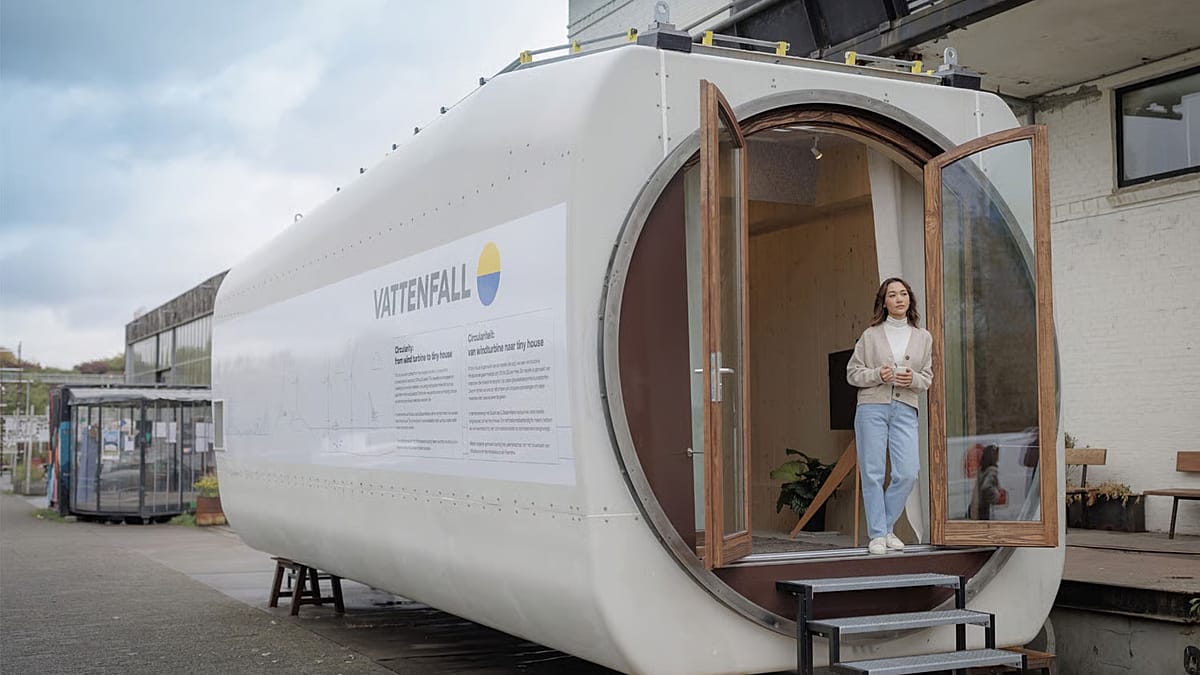 Retired wind turbines are turning into tiny homes and alpine skis
euronews.com
Retired wind turbines are turning into tiny homes and alpine skis
euronews.com
A Swedish energy company is experimenting with ways to reuse decommissioned wind turbine parts, turning hard-to-recycle components into products ranging from a compact living space to building facades and skis, Euronews reports. The projects focus on turbine blades and covers made of composite materials — the parts that do not fit neatly into standard recycling streams even as Europe continues to add wind capacity. WindEurope estimates Europe installed 8.8 gigawatts of new wind power in the first half of 2026, a year-on-year increase of about 30%.
Most of a turbine’s mass — steel, copper, aluminium and concrete — can be recycled, but blades are built from layered composites bound with resins that are difficult to separate without specialised processes. Euronews describes recycling methods that rely on high temperatures, which can lower the quality and value of recovered materials and make scaling harder. Sweden has banned landfilling of blades and certain turbine covers since 2021, pushing owners toward reuse, refurbishment or more complex recycling.
Vattenfall, working with the design studio Superuse, converted a retired nacelle cover into a compact living space that was shown at Dutch Design Week in 2024, according to Euronews. The structure is essentially a repurposed industrial shell outfitted with domestic systems including a kitchen and bathroom, alongside a heat pump and solar equipment. Elsewhere, blades from a Danish onshore wind farm were used as a facade for a multistorey car park in Lund, and similar blade sections have been trialled as frames for solar panels and even alpine skis.
The attraction is not just novelty. Reuse extends the working life of materials whose original design assumed decades of exposure to harsh weather, and it delays the moment when owners must pay for disposal or accept lower-value recovery. Vattenfall says it is aiming for full circularity for blade composites by 2030, while also developing mechanical recycling into composite flakes and experimenting with thermal processes such as pyrolysis to recover fibres.
For now, Euronews frames the tiny houses and blade-based construction as pilots meant to build know-how and stimulate a market. The more wind turbines Europe installs, the more those experiments will be tested by volume rather than design awards.