
US blocks more than 100 commercial ships near Iran
Centcom calls operation a steel wall after ceasefire framework collapses, diesel prices hit display limits at some California stations
Images
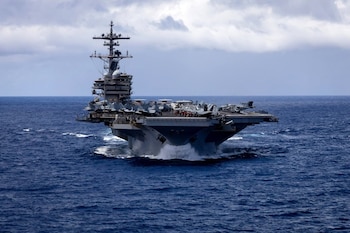 El portaaviones de la clase Nimitz USS George H.W. Bush navega por el océano Índico, en la zona de responsabilidad del Mando Central (CENTCOM) del Ejército de Estados Unidos, en el marco del cierre perimetral norteamericano del estrecho de Ormuz (CENTCOM EN X)
infobae.com
El portaaviones de la clase Nimitz USS George H.W. Bush navega por el océano Índico, en la zona de responsabilidad del Mando Central (CENTCOM) del Ejército de Estados Unidos, en el marco del cierre perimetral norteamericano del estrecho de Ormuz (CENTCOM EN X)
infobae.com
 El presidente de Estados Unidos, Donald Trump, participa en una ceremonia de llegada en Aras an Uachtarain, Dublín, Irlanda, el 12 de septiembre de 2026 (REUTERS/Kylie Cooper)
infobae.com
El presidente de Estados Unidos, Donald Trump, participa en una ceremonia de llegada en Aras an Uachtarain, Dublín, Irlanda, el 12 de septiembre de 2026 (REUTERS/Kylie Cooper)
infobae.com
 El presidente de Irán reconoció que la situación económica es “crítica y peligrosa” tras las sanciones de EEUU (Sputnik/Alexander Kazakov/Pool via REUTERS)
infobae.com
El presidente de Irán reconoció que la situación económica es “crítica y peligrosa” tras las sanciones de EEUU (Sputnik/Alexander Kazakov/Pool via REUTERS)
infobae.com
 Trump Points Finger At Iran After Drone Attack Shuts Vital Saudi Oil Pipeline
timesnownews.com
Trump Points Finger At Iran After Drone Attack Shuts Vital Saudi Oil Pipeline
timesnownews.com
US forces have blocked more than 100 commercial vessels from transiting waters tied to Iran during the first 60 days of what Infobae describes as a renewed maritime blockade. The operation, attributed to an order by President Donald Trump after a June ceasefire framework was declared over, has coincided with a sharp jump in fuel prices that is now showing up on roadside signs as well as in government data.
According to Infobae, US Central Command has framed the effort as a “steel wall,” saying no ship has passed without US authorization since the blockade resumed in mid-July. Infobae also reports that during an earlier blockade phase in the spring, US forces diverted more than 140 vessels, disabled nine that disobeyed orders, and allowed more than 50 ships carrying humanitarian cargo to proceed. The article places the blockade in the context of renewed exchanges between Washington and Tehran from late August, and notes Iranian officials arguing that negotiations are pointless unless Washington accepts Iran’s conditions.
The immediate economic transmission mechanism is simple: shipping constraints and war-risk premiums become diesel and gasoline costs long before they become peace talks. Times Now, citing GasBuddy and the US Energy Information Administration, reports that some California stations have hit the maximum price their digital displays can show for diesel—$9.999 per gallon—while the national diesel average reached a record level. EIA data cited by Times Now puts California’s average diesel price far above the national average, with prices rising week-on-week and sharply year-on-year.
When diesel spikes, the cost is not confined to motorists. Diesel is the fuel for freight, construction equipment, farm machinery, and backup generators; it is also a line item that gets repriced quickly because many businesses buy it frequently and in bulk. A blockade that interrupts predictable passage through a key corridor does not need to stop all flows to raise the cost of moving everything else, especially when insurers, shipowners, and commodity traders price in the chance of escalation rather than the baseline scenario.
Infobae notes that Iran has said it will discuss provisional “safe” routes with Oman, with Gulf states expected to participate. The same report quotes Iran’s president describing the country’s situation as “critical and dangerous” after months of sanctions and war, while Trump is quoted predicting the conflict will end after US midterm elections and that oil will then fall.
For now, the most concrete measure of the blockade is not a communiqué in Muscat or New Delhi but a fuel pump in California that has run out of digits.