
Macron and von der Leyen push European space buildup
IRIS² constellation accelerated as war and trade pressure reshape satellite policy, US firms reportedly skip Paris summit
Images
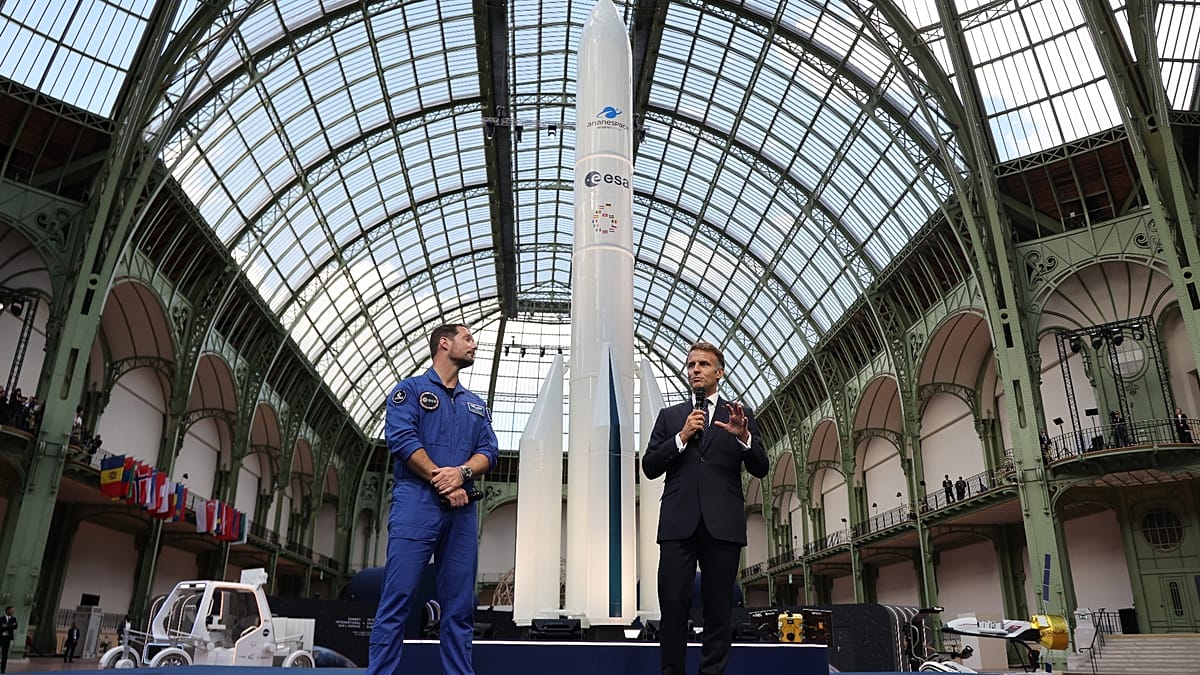 Macron and von der Leyen back stronger European space sector in Paris
euronews.com
Macron and von der Leyen back stronger European space sector in Paris
euronews.com
More than 51 deals were due to be signed at a Paris summit where Emmanuel Macron and Ursula von der Leyen urged Europe to strengthen a space sector Macron called “fragile.” According to Euronews, the event at the Grand Palais—co-hosted by France and Germany—was framed around security concerns as much as science, with von der Leyen arguing that “security on Earth increasingly depends on security in space.”
The immediate backdrop is Ukraine and the way modern war leans on satellites for communications and imagery. Von der Leyen cited battlefield connectivity and the ability to observe movements from hundreds of kilometres away, presenting Europe’s space build-out as a defence requirement rather than an industrial trophy. Euronews also reports that the EU has decided to accelerate its IRIS² satellite constellation by expanding it to more than 350 satellites, signalling that Brussels wants a system large enough to matter in a world where commercial constellations can be switched on—or off—by corporate and foreign-policy decisions.
Money and governance sit underneath the rhetoric. Euronews says roughly €20 billion of investments are expected during the summit, while Europe has historically spent 0.07% of GDP on space compared with 0.24% in the US. The European Space Agency approved a record €22.3 billion budget for its 2026–2028 cycle in late 2025, and Euronews refers to a €35 billion budget for space tied to security and defence. Macron called for “shared governance” of the European space industry, a phrase that reflects a recurring European problem: national programmes, EU procurement, and ESA planning often pull in different directions even when they fund overlapping capabilities.
The summit also brought a reminder that space policy is now trade policy. A French ministry spokesperson told Euronews that several US companies—including SpaceX and Blue Origin—withdrew from the event, with the spokesperson linking the decision to rumours of pressure from Washington in the press. Euronews describes the broader European push as partly driven by a desire to reduce dependence on the US in space, an ambition that becomes harder when key launch and satellite suppliers are American and when transatlantic politics can reach into conference guest lists.
Euronews lists milestones meant to anchor the pitch: a first European cargo capsule, Nyx, docking with the International Space Station in two years; a European lunar lander, Argonaut, expected to reach the Moon in five; and a first European crewed capsule launching from Kourou in French Guiana in ten. The summit featured ESA director Joseph Aschbacher and a live call with astronaut Sophie Adenot, currently on a nine-month ISS mission.
At the Grand Palais, Europe’s leaders talked about autonomy in orbit. The companies that stayed away were named in a ministry briefing.