
Amazon cargo plane crashes at Miami International Airport
Runway overrun shuts down airfield as fire crews respond, Prime delivery brand relies on contractors when the bill comes due
Images
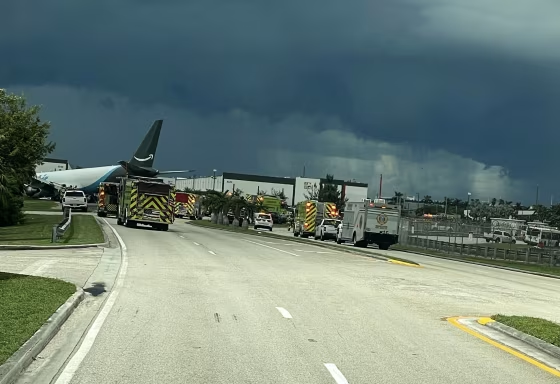 Emergency vehicles gathered near a jet at an airport under stormy skies.
nbcnews.com
Emergency vehicles gathered near a jet at an airport under stormy skies.
nbcnews.com
 The site of a cargo plane crash in Miami, Florida, on Sunday. Photograph: Marco Bello/Reuters
theguardian.com
The site of a cargo plane crash in Miami, Florida, on Sunday. Photograph: Marco Bello/Reuters
theguardian.com
A cargo jet carrying Amazon branding crashed after overrunning a runway at Miami International Airport on Sunday afternoon, prompting an air-and-ground stop and the closure of runways and taxiways, according to NBC News. Video from the scene showed thick smoke and a fire near the airport perimeter as Miami-Dade Fire Rescue units responded. The Federal Aviation Administration said it would investigate.
NBC reports the aircraft was a contractor-operated flight for Amazon, run by 21 Air, and arrived from San Juan, Puerto Rico. The plane came to rest outside the airfield, with footage showing it on or near a roadway beyond the airport boundary. Officials said there were “multiple patients” involved, but early reports did not provide a confirmed count of injuries or any fatalities.
The disruption illustrates how tightly modern retail logistics is coupled to a small number of high-throughput airports. Miami is not merely a passenger hub; it is a freight gateway for time-sensitive shipments, and a runway closure there ripples outward into missed connections, diverted flights, and delayed cargo transfers across the network. When a single aircraft disables part of an airfield, the cost is not limited to the operator: airlines, travelers, and other shippers absorb delays first, while investigators and insurers sort out liability later.
It also highlights the branding arrangement behind “Amazon flights.” Amazon Prime Air depends heavily on contractors and leased aircraft rather than a single vertically integrated airline. That structure can spread operational capacity quickly, but it also spreads accountability across multiple entities: the platform that sells speed, the contractor that flies the route, the airport that manages runway and taxiway availability, and the federal agencies that oversee safety. In incidents like this, the public sees the Amazon logo, while the regulatory and legal paperwork runs through the operator of record.
The FAA said it will investigate the runway overrun, while the National Transportation Safety Board was reported to be gathering information. By mid-afternoon, Miami International Airport remained under a ground stop as emergency crews worked at the crash site.