
Simon Tisdall: global disorder spreads as alliances fray
He links bond-market stress to shrinking political room for manoeuvre, ordinary protest becomes the column’s only proposed counterweight
Images
 A sit-in organised by the Cockroach Janta party, an Indian youth protest movement, Delhi, 6 June 2026. Photograph: Adnan Abidi/Reuters
theguardian.com
A sit-in organised by the Cockroach Janta party, an Indian youth protest movement, Delhi, 6 June 2026. Photograph: Adnan Abidi/Reuters
theguardian.com
 Simon Tisdall
theguardian.com
Simon Tisdall
theguardian.com
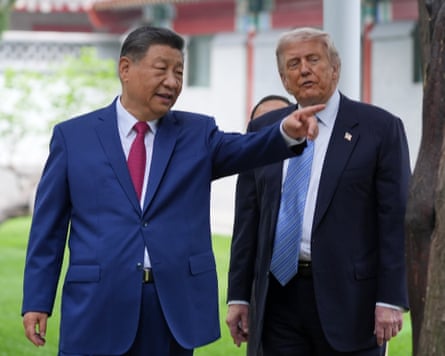 Donald Trump and Xi Jinping in Beijing, 15 May 2026. Photograph: Mark Schiefelbein/AP Pool/AP
theguardian.com
Donald Trump and Xi Jinping in Beijing, 15 May 2026. Photograph: Mark Schiefelbein/AP Pool/AP
theguardian.com
Simon Tisdall warns of a world sliding into wider war, he cites bond-market stress and broken alliances, and his remedy is faith in ordinary people rather than leaders
A sit-in organised by India’s Cockroach Janta youth movement in Delhi on 6 June is Simon Tisdall’s opening image for a world he says is tipping toward disorder, in a Guardian column published on 6 September. He strings the local protest to a global inventory: unending wars, expanding humanitarian crises, rising authoritarianism, dysfunctional democracies, and what he calls unchecked lawlessness, alongside widening inequality, heavy government debt, proliferating nuclear weapons and “dangerous AI gambles”.
Tisdall ties the mood to recent market discipline. He writes that upheaval in global bond markets last week pushed up borrowing costs and left Britain’s government struggling, a reminder that even large states can find their room for manoeuvre shrinking when lenders demand a higher price. Britain’s new prime minister, Andy Burnham, has talked of a “new era of possibility”, but the column presents his first months as constrained by outside shocks and security commitments, including Burnham choosing Ukraine for his first overseas trip and Britain positioning itself as a lead opponent of Vladimir Putin’s invasion.
The column’s geopolitical map is built around fraying alliances and opportunistic linkages. Tisdall says the post-1945 alliance system is deteriorating and describes Donald Trump taunting Europe and Nato with tariffs, troop-withdrawal threats and insults “during a time of acute vulnerability”. He sketches a chain of cooperation among adversaries—China aiding North Korea, North Korea aiding Russia, Russia aiding Iran, and Iran aiding Hezbollah and the Houthis—while arguing that Washington’s relationships in Asia are also under strain, with partners in Japan, South Korea, the Philippines and Australia viewing China as menacing as confidence in the US wobbles.
He also places the Middle East and its spillovers at the centre of the current cycle. Israel’s response to the 2023 massacres, he writes, has set off an ongoing regional war involving Palestine, Lebanon, Syria, Yemen, Iraq, Iran and Gulf states. Elsewhere, he points to “appalling atrocities” in southern Sudan and a people’s war against a brutal junta in Myanmar, and he claims Trump has “lost his Iran bet” while continuing bombing with no clear endpoint.
The human consequences, in Tisdall’s telling, are mass displacement and an overwhelmed aid architecture. He writes that humanitarian crises driven by war, climate pressures and disasters are producing chaotic migrations, malnutrition and disease, while the UN-led aid system is “crippled” by US and UK funding cuts. Against that backdrop, his proposed route out is not another summit or strategy paper but the capacity of ordinary people—protest movements, civil society and voters—to resist predatory leaders.
Tisdall’s evidence comes from the same places his argument says are failing: bond markets that reprice state promises overnight, and alliances that depend on leaders who can reverse course with a speech. He begins with a youth sit-in and ends with the claim that citizens are the remaining counterweight when governments and institutions cannot keep their own systems stable.