
Putin meets Steve Witkoff and Jared Kushner in Kremlin
Three-day pause in strikes on Kyiv and Moscow enables US shuttle talks, ceasefire remains narrower than the travel plan
Images
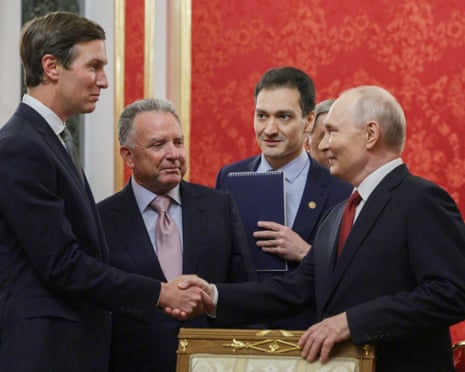 The Russian president, Vladimir Putin, welcomes Jared Kushner (left) and US envoy Steve Witkoff (second left) to the Kremlin. Photograph: Gavriil Grigorov/Sputnik/Kremlin/EPA
theguardian.com
The Russian president, Vladimir Putin, welcomes Jared Kushner (left) and US envoy Steve Witkoff (second left) to the Kremlin. Photograph: Gavriil Grigorov/Sputnik/Kremlin/EPA
theguardian.com
 eurasiabusinessnews.com
 eurasiabusinessnews.com
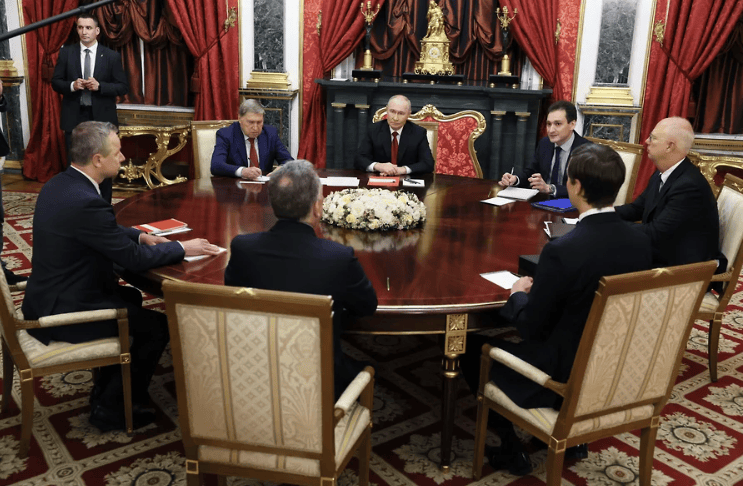
Vladimir Putin held a closed-door Kremlin meeting with US envoys Steve Witkoff and Jared Kushner as Washington tried to restart talks on ending the war in Ukraine, according to The Guardian and Eurasia Business News. The visit coincided with a limited three-day pause in strikes on Kyiv and Moscow intended to allow the US delegation to travel between capitals. The Kremlin said the meeting lasted around three hours and included senior Russian officials Yuri Ushakov and Kirill Dmitriev.
The delegation’s profile is unusual even by the standards of back-channel diplomacy. Kushner is best known as a real-estate investor and Trump family figure; Witkoff is also a real-estate executive who, according to Eurasia Business News, has met Putin repeatedly since Trump returned to office. That choice matters because it shifts a negotiation that normally runs through diplomats, uniformed officials, and legislative oversight into a narrower circle where access itself is the currency. When talks depend on a small set of intermediaries, the leverage is not only in what is promised at the table but in who gets to be in the room.
The pause in strikes illustrates how small, concrete concessions can be packaged as diplomatic momentum without touching the core dispute. The Guardian reports the Kremlin reaffirmed Putin’s position that Ukraine should give up four regions claimed by Russia and not join Nato—terms Kyiv has described as intolerable. The same article notes the war has ground into a stalemate along a long frontline while aerial attacks reach deeper behind it, making “not striking the capitals” a narrow exception rather than a change in the war’s mechanics. Russia’s decision to halt attacks on Kyiv from midnight for three days, and Ukraine’s pledge to refrain from strikes on Moscow over the same period, created a corridor for a visiting delegation, not a ceasefire.
For Washington, the optics cut both ways. Trump described the trip as carrying “a proposal to end the war,” but did not disclose details, The Guardian reports. Eurasia Business News says Putin asked the envoys to convey his thanks to Trump and described trusting them as intermediaries—language that signals a preference for personal channels over institutional ones. The same piece ties the talks to quieter US-Russia contacts around detainee cases, including the release of a former US Marine in early August, suggesting that side-deals and humanitarian files can keep lines open even when the front line does not move.
Kushner and Witkoff were expected to travel on to Kyiv to meet Volodymyr Zelensky, according to both outlets. The three-day window ends quickly; the positions on territory and alliances do not.
The only agreement publicly visible so far is a temporary halt on strikes against two capitals so the negotiators can fly in and out safely.