
WNBA commissioner Cathy Engelbert retires at end of 2026
Media-rights boom and new CBA reshape league economics, record audiences arrive alongside open player hostility
Images
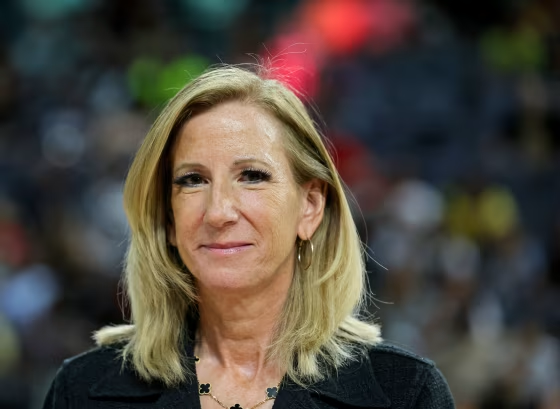 WNBA Commissioner Cathy Engelbert.
nbcnews.com
WNBA Commissioner Cathy Engelbert.
nbcnews.com
WNBA commissioner Cathy Engelbert will retire at the end of 2026, closing a tenure that coincided with a surge in media-rights money and a steady stream of player criticism over how the league is run. NBC News reports that Engelbert, who has led the league since 2019, will step down after a period that included pandemic-era disruption, expansion plans, and a new collective bargaining agreement.
Engelbert’s exit lands after the WNBA locked in a new pay and revenue structure that players had publicly pushed for. According to NBC News, the league and players agreed to a new CBA in March 2026 that included $1 million salaries for the first time and introduced a new revenue-sharing model. At the same time, the commissioner’s office became a frequent target for complaints about officiating, labour negotiations and the league’s handling of high-voltage public debates. NBC News notes that Minnesota Lynx star Napheesa Collier said in 2025 that the WNBA’s leadership was “the worst in the world,” arguing the larger problem was a lack of accountability from the league office.
The money, however, has been moving in the opposite direction. NBC News points to a 2024 television deal involving Disney, Amazon and NBCUniversal, and says additional partners later pushed the total rights value higher. The league is also planning to expand to 18 teams by 2030, with new franchises scheduled in San Francisco, Toronto and Portland before later additions in Cleveland, Detroit and Philadelphia.
That growth has made the WNBA less dependent on any single broadcaster while increasing the stakes of every programming decision. More partners mean more windows to fill, more sponsor commitments to satisfy, and more pressure to keep the product predictable enough for mass audiences without flattening the league’s identity. When athletes publicly challenge the league office, the dispute is no longer just internal governance; it becomes content, and it competes with the games themselves for attention.
Engelbert’s tenure began with crisis management — the 2020 season was played in a Florida bubble during the Covid-19 pandemic — and ends with record audiences that broadcasters can package and sell. NBC News cites an August 26 game between the Indiana Fever and Chicago Sky that averaged 3.31 million viewers across NBC and Peacock, the league’s most-watched game since its inaugural season in 1997.
Engelbert will leave a league that has more teams on the way than it has stable consensus on what its leadership should be accountable for.