
Genetically modified pig kidney keeps patient off dialysis for nine months
Massachusetts general hospital uses xenotransplant as bridge to human donor organ, longest case still ends with conventional transplant
Images
 Tim Andrews in his room at Massachusetts general hospital four days after receiving the genetically modified pig kidney. Photograph: Kate Flock/Massachusetts general hospital/PA
theguardian.com
Tim Andrews in his room at Massachusetts general hospital four days after receiving the genetically modified pig kidney. Photograph: Kate Flock/Massachusetts general hospital/PA
theguardian.com
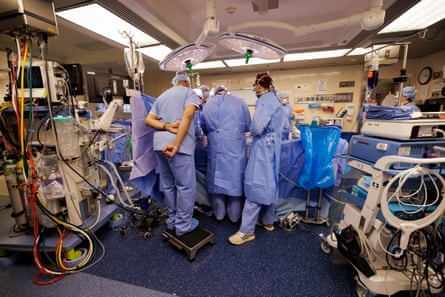 Surgeons during the procedure at Massachusetts general hospital on 25 January 2025. Photograph: Kate Flock/Massachusetts general hospital/PA
theguardian.com
Surgeons during the procedure at Massachusetts general hospital on 25 January 2025. Photograph: Kate Flock/Massachusetts general hospital/PA
theguardian.com
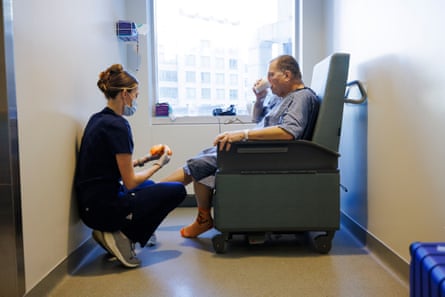 Andrews with nurse Melanie Brodner at Massachusetts general hospital on 29 January 2025, four days after his pig kidney transplant. Photograph: Kate Flock/Massachusetts general hospital/PA
theguardian.com
Andrews with nurse Melanie Brodner at Massachusetts general hospital on 29 January 2025, four days after his pig kidney transplant. Photograph: Kate Flock/Massachusetts general hospital/PA
theguardian.com
 standard.co.uk
 standard.co.uk
 standard.co.uk
 standard.co.uk
 standard.co.uk
A genetically modified pig kidney kept an American patient alive and off dialysis for 271 days before he received a human donor organ, according to a case report published in The Lancet and covered by The Guardian. The kidney, from a Yucatan miniature pig named Wilma, was transplanted into Tim Andrews at Massachusetts General Hospital as a temporary “bridge” while he waited for a human kidney. Doctors said the graft ultimately began to fail, after which Andrews returned briefly to dialysis and then underwent a conventional transplant from a deceased donor.
The headline number—nine months—matters because prior pig-to-human kidney transplants in living recipients have generally failed within weeks. The Guardian reports that the first such transplant in a living person occurred in 2024 and lasted 52 days before the patient died of unrelated heart problems, and that earlier work had not documented survival beyond roughly two months. In this case, the pig kidney was engineered with dozens of genetic edits intended to reduce rejection and lower the risk of virus transmission, a technical response to two practical constraints: the immune system’s speed at destroying foreign tissue, and the limited supply of human organs.
That supply constraint shapes the economics of transplantation. Waiting lists are long, eligibility can be lost through deteriorating health, and dialysis is both costly and physically punishing—creating a niche for a stopgap organ that does not need to last decades to change outcomes. A “bridge” transplant also changes the risk calculus for hospitals and regulators: it aims for months of function rather than a lifetime, potentially lowering the bar for initial clinical use while still exposing patients to major surgery and heavy immunosuppression. Even if the approach proves repeatable, it would move part of the transplant system toward an industrial input—standardised animal organs produced on demand—rather than a scarce gift dependent on human donation.
The same features that make xenotransplantation scalable also make it politically and ethically fraught. Genetic engineering, animal husbandry, and biosecurity controls become integral to routine care, and the line between emergency innovation and normalised practice is set by institutions that benefit from expanding high-end procedures. For now, the evidence remains a single documented case with an unusually long dialysis-free period, not a mature therapy.
Andrews’ surgeons were able to point to a concrete improvement that patients understand: for months he could live without dialysis while waiting for a human kidney. The pig kidney did not become a permanent replacement, but it lasted long enough to change what “waiting for a donor” looked like in one hospital bed.