
Goldmine collapse kills more than 100 in Central African Republic
Landslide buries artisanal miners in Zamboye near Cameroon border, heavy machinery speeds recovery as survivor chances fade
Images
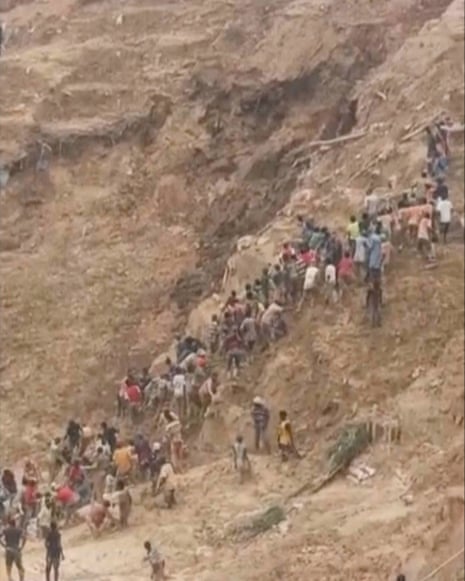 Screenshot of verified video the shows the goldmine collapse in the Central African Republic with more than 100 reported dead. Photograph: AP
theguardian.com
Screenshot of verified video the shows the goldmine collapse in the Central African Republic with more than 100 reported dead. Photograph: AP
theguardian.com
More than 100 people have died after a landslide collapsed an artisanal goldmine in the village of Zamboye in western Central African Republic, according to Reuters and the Associated Press. The incident happened on Tuesday afternoon, with rescuers still searching for survivors as bodies are recovered from under sand and debris. The number of people in the mine at the time remains unknown, and local authorities have opened an investigation, according to local media cited by The Guardian.
The accounts of how the mine failed point to a familiar pattern in informal extraction: work moves underground faster than safety oversight can follow. A prosecutor in Baboua said the collapse was believed to involve several underground tunnels where miners were working, while a miner, Cedric Mbango, described the ground giving way and burying people. Social media footage reviewed by outlets showed an avalanche of sand sweeping over a group of people, likely miners, compressing what would normally be a complex rescue into a race against time.
The rescue itself illustrates the trade-offs that appear when capacity is thin. Corbeau News, a Central African news website, reported the use of heavy machinery including tractors to retrieve bodies—equipment that can speed recovery but also risk destabilising the site and reducing the chances of finding survivors alive. A local prosecutor said many others were trapped but did not specify how many, leaving families and responders operating in uncertainty as the death toll is expected to rise.
Cross-border labour flows are built into the economics of these sites. The miners were believed to include nationals from both Central African Republic and Cameroon, and officials in Cameroon’s Eastern region said at least three Cameroonian citizens had been identified among the victims. The governor of that region, Grégoire Mvongo, said he was working closely with Central African counterparts on the aftermath—administrative coordination arriving after the fact, once the costs are already paid.
Artisanal mines remain common in parts of Africa even where regulations criminalise them, and The Guardian notes unemployment pushes able-bodied men toward abandoned or unused mines to earn a living. In Central African Republic alone, at least 40 people have died in several mining incidents this year, a toll that suggests repeated site-by-site failures rather than a one-off accident.
In Zamboye, a youth council member told reporters that finding survivors would be “a miracle.” Rescuers are still digging through sand in a village where nobody can yet say how many people went down into the tunnels that afternoon.