
Trump pauses planned 50% Canada tariffs
White House says trade deal awaits paperwork, Keystone XL revival floats as bargaining chip
Images
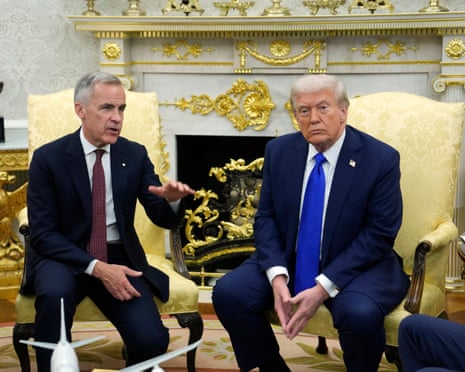 Mark Carney and Donald Trump at the White House in Washington DC on 7 October 2025. Trump has paused tariffs on Canada for three days. Photograph: Adrian Wyld/The Canadian Press/AP
theguardian.com
Mark Carney and Donald Trump at the White House in Washington DC on 7 October 2025. Trump has paused tariffs on Canada for three days. Photograph: Adrian Wyld/The Canadian Press/AP
theguardian.com
Donald Trump has paused a planned 50% tariff on Canadian goods for three days, saying the two countries have a deal pending final paperwork. The Guardian reports the announcement came in a late-night social-media post, after weeks of renewed tariff threats and last-minute talks between senior officials. Canada’s prime minister, Mark Carney, said “substantial progress” had been made, while warning that more work remained.
The pause is small in calendar time but large in signalling. A 50% levy is not a technical adjustment; it is a supply-chain shock that forces importers to reprice contracts, shift orders, or hold inventory they can’t sell. The Guardian says the threatened tariffs would have covered about $20bn of Canadian goods and hit exports including wine and hockey sticks—consumer-facing items that turn trade policy into immediate retail inflation. It also underlines how much North American trade now lives outside the comfort of the USMCA: the paper notes that some goods previously protected under the pact are not protected from the latest tariffs, leaving companies to discover in real time which rules still bind.
The episode fits a pattern that has defined the relationship since the White House imposed a 25% tariff in early 2025, citing cross-border illegal immigration and drug trafficking. Canada rejected the premise, pointing to claims that less than 1% of fentanyl and illegal crossings came from Canada, and retaliated with its own tariffs. The more recent 50% threat, announced in July 2026, was framed as punishment for alleged discrimination against US-made cars, alcohol and dairy—an escalation that would have shifted the dispute from targeted pressure to broad-based taxation of everyday trade.
Trump’s same post also floated reviving the Keystone XL pipeline, saying the project “may be awoken from the grave,” without details. Keystone XL, proposed in 2008 and halted in 2021 after Joe Biden revoked a key permit and TC Energy later stopped work, has long been less a single infrastructure project than a recurring bargaining chip: landowners, Native American tribes and environmentalists fought it in the US, while Canadian producers saw it as a route to higher-value refining markets. Bringing it back into the conversation while tariff documents are being “finalized” turns a trade negotiation into a broader package of energy, regulation, and cross-border leverage.
The tariff clock is now set to three days. The paperwork, and whether the tariff threat returns on schedule, will be the first measurable output of the “deal” Trump says already exists.