
European drought cuts harvest forecasts
France projects sharp maize drop as Italy reports widespread farmland stress, relief politics follows once rationing replaces rainfall
Images
 The French agriculture ministry estimates its maize harvest will be down 35% on 2025 levels. Photograph: Mourad Allili/SIPA/Shutterstock
theguardian.com
The French agriculture ministry estimates its maize harvest will be down 35% on 2025 levels. Photograph: Mourad Allili/SIPA/Shutterstock
theguardian.com
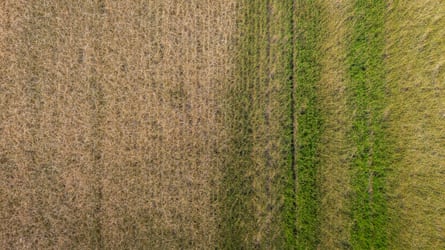 An aerial view of a rice field in Italy earlier this month showing a sharp contrast between a yellowed and dried section affected by severe heat stress and the remaining area where rows of green rice plants are still visible in Novara, in the Po valley, where growers have been forced to irrigate crops only on alternate weeks. Photograph: Simone Padovani/Getty Images
theguardian.com
An aerial view of a rice field in Italy earlier this month showing a sharp contrast between a yellowed and dried section affected by severe heat stress and the remaining area where rows of green rice plants are still visible in Novara, in the Po valley, where growers have been forced to irrigate crops only on alternate weeks. Photograph: Simone Padovani/Getty Images
theguardian.com
French farm officials are now projecting a maize harvest roughly a third lower than last year’s, a drop the ministry says would put output near levels last seen decades ago. In Italy, the farmers’ group Coldiretti says drought conditions are affecting a majority of farmland, with the Po valley among the hardest-hit areas. The Guardian reports growers across Europe describing successive heatwaves and a continent-wide drought as a crisis that is no longer regional but simultaneous.
The immediate damage shows up first where agriculture is least flexible: vegetables that cannot be left in the ground, dairy herds that cannot be “paused,” and irrigation systems that depend on water being available when plants need it. In France, producer groups cited by the Guardian estimate large shortfalls for common vegetables, while the agriculture ministry projects a steep fall in maize volumes. The canned and frozen vegetable industry’s representative told the paper that multiple production areas were hit at once, removing the usual option of shifting supply across regions. Livestock producers face a second squeeze: less feed, and animals that produce less under heat stress, with French dairy farmers reporting lower yields and French hay production for winter forage running well below long-term averages.
The wider pattern is that drought is turning into a balance-sheet problem long before it becomes a supermarket shortage. Farmers can switch crops, but those choices are made years in advance around equipment, contracts, and local know-how; the Guardian notes some French farmers have moved away from maize, but that is itself part of the volume decline. Where irrigation water is rationed, as reported in parts of northern Italy, the constraint is no longer price but permission—who gets to pump, and when. That pushes losses into other parts of the economy: processors that need predictable volumes, insurers and lenders reassessing risk, and governments pulled toward relief schemes that spread costs to taxpayers who do not share in good years.
By mid-August, the story is being told in production forecasts and mortality figures rather than in rhetoric. The Guardian’s reporting leaves a simple picture: Europe’s farm output is being negotiated week by week against heat, water access, and the limits of what can be moved across borders when everyone is short at the same time.