
DR Congo Ebola outbreak becomes country’s deadliest
Bundibugyo strain spreads without approved vaccine or treatment, case detection still arrives after community deaths
Images
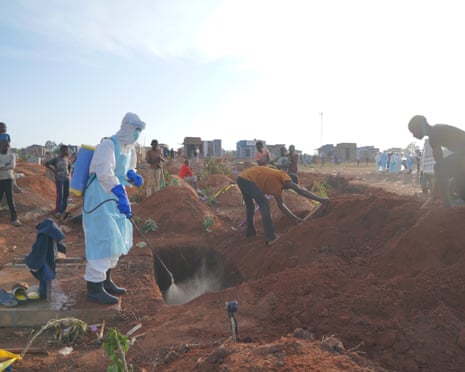 A health worker sprays disinfectant in a freshly dug grave of someone who died of Ebola, in Bunia, Democratic Republic of the Congo. Photograph: Dieudonne Dirole/AP
theguardian.com
A health worker sprays disinfectant in a freshly dug grave of someone who died of Ebola, in Bunia, Democratic Republic of the Congo. Photograph: Dieudonne Dirole/AP
theguardian.com
Congo’s current Ebola outbreak has killed at least 2,325 people, according to government data cited by The Guardian, overtaking the country’s 2018–20 epidemic. The Democratic Republic of Congo’s public health institute reported 4,945 confirmed cases on Sunday, including 101 detected in the previous 24 hours. The outbreak has spread to six of the country’s 26 provinces, mainly along the north-eastern border, with more than 3,400 cases recorded in Ituri, where it began.
The virus this time is the Bundibugyo strain, a rarer variant for which there are no approved vaccines or treatments, The Guardian reports. That makes the usual containment playbook—rapid diagnosis, contact tracing, and early supportive care—harder to execute and easier to outrun. A public health specialist deployed with Médecins Sans Frontières told the paper that fatality rates normally fall as tracing improves, because patients are found earlier; instead, many cases are still being detected late, often only after a patient has died in the community. When the first time an infection becomes visible is at a funeral, the response system is reduced to paperwork.
International messaging has turned blunt. The United Nations warned on Friday that “Ebola is winning” in the DRC and described the pace as roughly one death every 30 minutes, language that signals both urgency and limited leverage. The World Health Organization declared the outbreak in the DRC and Uganda a public health emergency of international concern in May, and Uganda has since reported at least 20 cases, all in Kampala. The cross-border spread is not a mystery: Ebola transmits through direct contact with infected bodily fluids and contaminated materials, and outbreaks tend to exploit routine gaps—overcrowded clinics, informal caregiving, and under-resourced sanitation—more than they exploit ignorance.
The outbreak’s growth also exposes a recurring problem in fragile states: the people tasked with stopping contagion are asked to operate in places where basic security cannot be assumed. Earlier reporting on the outbreak has noted attacks on healthcare facilities that complicate tracing and treatment; even without a single “failed” intervention, the accumulation of delays—late detection, disrupted access, mistrust, and the absence of a targeted vaccine—produces a system where the virus gets more attempts than the responders do.
In Ituri, where thousands of cases have been recorded, the numbers now move faster than the infrastructure built to count them. The DRC’s public health institute added 101 new confirmed cases in a day, and the outbreak’s deadliest milestone arrived before a licensed Bundibugyo vaccine did.