
Jared Kushner meets Hamas political chief in Egypt
Talks precede Netanyahu meeting on US-backed Gaza road map, ceasefire plan hinges on disarmament and an undefined yellow line
Images
 Jared Kushner speaks during the 56th annual meeting of the World Economic Forum in Davos, Switzerland, on 22 January 2026. Photograph: Gian Ehrenzeller/EPA
theguardian.com
Jared Kushner speaks during the 56th annual meeting of the World Economic Forum in Davos, Switzerland, on 22 January 2026. Photograph: Gian Ehrenzeller/EPA
theguardian.com
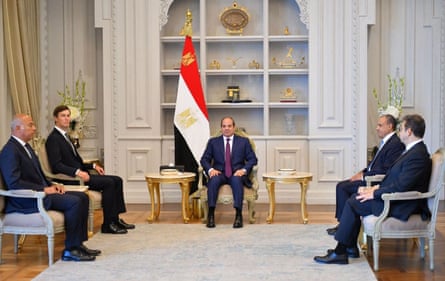 Egyptian president Abdel Fatah al-Sisi receives Jared Kushner in New Alamein, Egypt, on Sunday, in the presence of foreign minister Badr Abdelatty and general intelligence service chief Hassan Rashad. Photograph: Egyptian President Office/APAImages/Shutterstock
theguardian.com
Egyptian president Abdel Fatah al-Sisi receives Jared Kushner in New Alamein, Egypt, on Sunday, in the presence of foreign minister Badr Abdelatty and general intelligence service chief Hassan Rashad. Photograph: Egyptian President Office/APAImages/Shutterstock
theguardian.com
Jared Kushner held a rare meeting with Hamas’s political chief in Egypt on Sunday as diplomats try to revive a stalled Gaza ceasefire plan, according to an Associated Press report carried by The Guardian. The meeting, which lasted more than two hours, took place ahead of Kushner’s scheduled talks with Israeli prime minister Benjamin Netanyahu on Monday. The talks are aimed at salvaging a framework under which Hamas would disarm and Israel would withdraw from the Palestinian territory.
The episode highlights how ceasefire diplomacy in Gaza has been built around overlapping channels rather than a single, accountable negotiating table. The Guardian reports that Kushner was part of a trio of envoys meeting Hamas leader Khalil al-Hayya, with officials from Egypt, Qatar and Turkey also present. That mix matters: each intermediary has different leverage, and each can claim progress without owning the costs of enforcement if the plan collapses.
The plan’s bottleneck is disarmament. A meeting last year between Kushner, envoy Steve Witkoff and Hamas leaders helped clinch a ceasefire, but progress has since stalled on the question of weapons. Hamas, the report says, is asking for Israel to halt attacks and withdraw to a so‑called “yellow line” before implementation begins, even though the line was never precisely defined. Israeli forces have moved beyond it and now control about 60% of Gaza, turning a vague term into a practical argument over maps and checkpoints.
Netanyahu has publicly rejected a new 15‑point US‑backed road map, a move that has drawn a joint condemnation statement from several regional powers including Saudi Arabia and the United Arab Emirates, alongside Jordan, Pakistan, Indonesia and the ceasefire mediators. The foreign ministers’ statement called on the US-created Board of Peace overseeing the ceasefire to take “immediate and concrete measures” against obstruction. That phrasing points to the central problem: the architecture can issue demands, but it still needs a mechanism to impose consequences.
Kushner’s role also illustrates why governments use private or semi-private figures in conflicts where official positions are boxed in by domestic politics. Kushner can test Hamas’s willingness to accept disarmament terms before Netanyahu is asked to move, and he can do it in a meeting that is confirmed only through anonymous officials. For Hamas, the meeting offers a way to signal commitment to mediators while keeping its public posture focused on Israeli withdrawal. For Israel, it creates another forum to resist a plan while claiming engagement.
Egyptian president Abdel Fatah al-Sisi received Kushner in New Alamein on Sunday, with Egypt’s foreign minister and intelligence chief present, underscoring that state power still sits behind the “envoy” label. The next step, however, is a Monday meeting in which Kushner, Tony Blair and the Board of Peace director Nickolay Mladenov are expected to sit down with Netanyahu.
The ceasefire framework depends on a 14‑day negotiation period that begins only if all parties approve the road map. On Sunday, approval was still being sought in side rooms in Egypt.