
Madrid hospital implants personalised bone metamaterial prosthesis
Gregorio Marañón team and Polytechnic University of Madrid use 3D-printed titanium lattice to spare a sarcoma patient’s leg, aerospace-derived design moves complexity from metal to geometry
Images
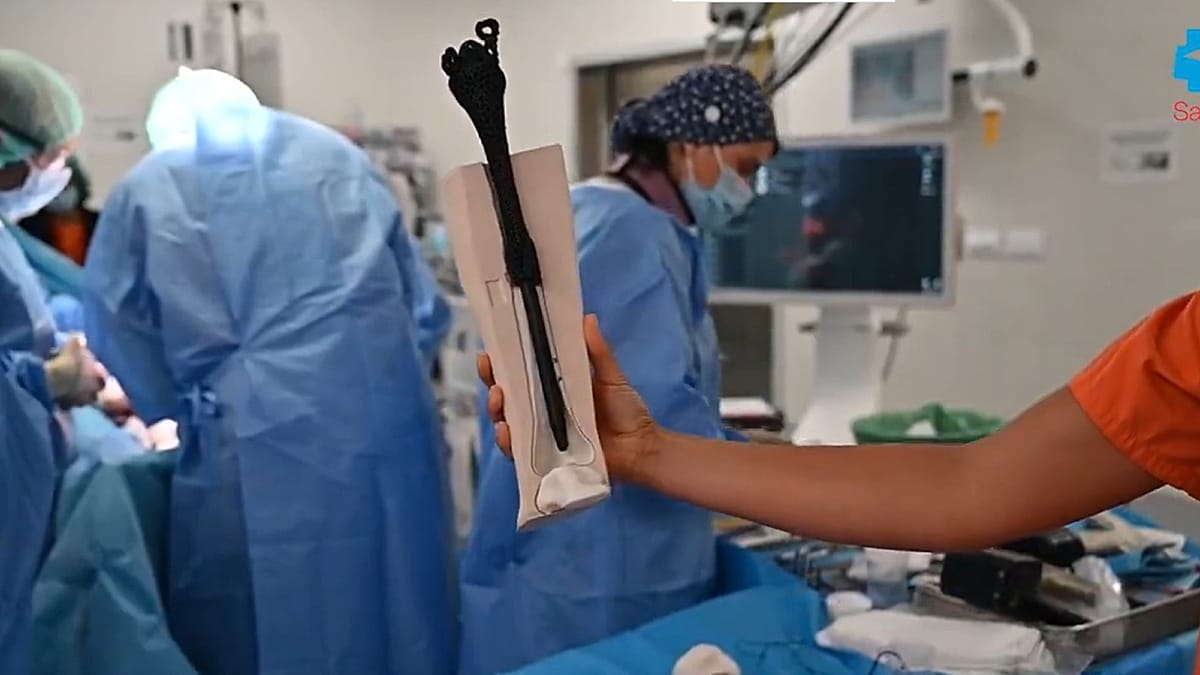 Madrid hospital creates first bone metamaterial prosthesis, prevents leg amputation
euronews.com
Madrid hospital creates first bone metamaterial prosthesis, prevents leg amputation
euronews.com
A Madrid public hospital has implanted what it calls the world’s first personalised “bone metamaterial” prosthesis, replacing part of a patient’s tibia and avoiding a leg amputation, according to Euronews. The device was designed and implanted at Gregorio Marañón Hospital in collaboration with engineers at the Polytechnic University of Madrid. The hospital says the patient had a high-grade bone sarcoma and, a year after surgery, is able to walk.
The core claim is not simply a new implant, but a change in what the implant is trying to imitate. Conventional limb-sparing reconstructions often rely on solid metal components that replace missing bone with a rigid substitute; they can be heavy and can concentrate stress in ways that lead to loosening, fractures, or repeat surgeries. The Madrid team describes its prosthesis as a lattice of millimetre-scale titanium structures, produced with 3D printing, intended to distribute loads more like real bone and to encourage integration as tissue grows into the structure. Euronews reports the design process used radiological imaging to build a “digital twin” of the patient’s healthy leg and then simulated forces from walking, climbing stairs, and stumbling to determine internal geometry and screw placement.
The hospital also frames the project as a transfer of techniques from aerospace engineering into orthopaedic surgery: the “metamaterial” concept is presented as an engineered structure whose mechanical behaviour comes from geometry rather than bulk material. That matters because it shifts the bottleneck from sourcing a stronger alloy to designing and manufacturing a structure that behaves predictably inside a body. Euronews reports the team believes patient-specific design can reduce operating time compared with conventional solutions, and it says the hospital has already performed a second similar procedure while preparing additional personalised implants for other parts of the body.
The immediate evidence remains narrow: a single highlighted case, plus a second procedure mentioned without outcomes, and hospital plans for more implants. But the direction is concrete. A patient who had been unable to bear weight for an extended period is now walking with a custom titanium structure built from his scans.
The prosthesis was not presented as a mass-produced device. It was printed to fit one leg, for one operation, in one hospital.