
Israeli strikes kill nine in southern Lebanon
Worst toll since June lull between Israel and Hezbollah, homes outside security zone flattened as civilians flee north
Images
 A man inspects the damage after an Israeli airstrike on homes in the village of Ansar in southern Lebanon. Photograph: Xinhua/Shutterstock
theguardian.com
A man inspects the damage after an Israeli airstrike on homes in the village of Ansar in southern Lebanon. Photograph: Xinhua/Shutterstock
theguardian.com
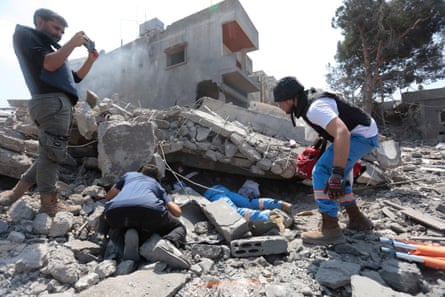 Rescue workers and residents search for survivors after an Israeli airstrike on Deir al-Zahrani in southern Lebanon. Photograph: Abdul Kader Al Bay/Zuma Press Wire/Shutterstock
theguardian.com
Rescue workers and residents search for survivors after an Israeli airstrike on Deir al-Zahrani in southern Lebanon. Photograph: Abdul Kader Al Bay/Zuma Press Wire/Shutterstock
theguardian.com
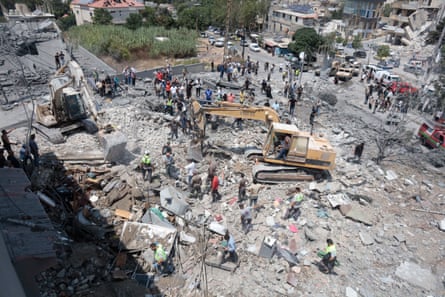 An aerial view of the damage in Deir al-Zahrani after an Israeli warplane carried out an airstrike in southern Lebanon. Photograph: Abdul Kader Al Bay/Zuma Press Wire/Shutterstock
theguardian.com
An aerial view of the damage in Deir al-Zahrani after an Israeli warplane carried out an airstrike in southern Lebanon. Photograph: Abdul Kader Al Bay/Zuma Press Wire/Shutterstock
theguardian.com
Nine people were killed and 11 injured in two Israeli airstrikes in southern Lebanon on Saturday, according to Lebanese state media and reporting by the Guardian. One strike hit a home on the outskirts of the village of Ansar, flattening the building and killing seven people including children; another hit a home in Deir al-Zahrani, killing two and wounding nine. The deaths mark the worst toll since June deals brought a lull in hostilities between Israel and Hezbollah.
The strikes come in the grey zone that has followed the June arrangements: a formal easing of fighting paired with intermittent attacks that still destroy homes and push civilians onto the roads. The Guardian reports that neither Ansar nor Deir al-Zahrani lies inside Israel’s self-declared “security zone” in southern Lebanon, territory Israeli forces occupy; yet the Israeli military framed the attacks as a response to Hezbollah fighters attacking soldiers in the Ali Taher area, a hill Israel says contains underground command-and-control sites. Lebanese Prime Minister Nawaf Salam condemned the raids as “extremely dangerous” and said they undermined efforts to stabilise the south, disputing Israel’s characterisation by saying the dead were not “military infrastructure” and that women and children were among those killed.
Since March, the Lebanon front has been tied to a broader regional conflict, with the Guardian noting that Hezbollah began its latest rocket fire after the killing of Iran’s supreme leader, followed by an Israeli aerial campaign and invasion that killed thousands and left Israel occupying part of Lebanon. June then brought a US-Iran memorandum of understanding on the wider war and, later that month, a US-sponsored framework between Lebanon and Israel—diplomacy that reduced the tempo without removing the underlying triggers. In that environment, each side’s public explanation becomes part of the battlefield: Israel points to “infrastructure” and soldier safety; Lebanon points to homes, rubble, and casualty lists.
Operationally, the reporting describes an escalation that is legible to civilians first: rescue crews searching through a flattened house in Ansar; smoke and rubble in Deir al-Zahrani; traffic clogging roads out of Nabatieh as families fled north. The Israeli military has been shelling the Ali Taher area for months, according to the Guardian, suggesting a target set that persists regardless of ceasefire language. Lebanese state media also described strikes deeper than seen since the June lull, and reported additional raids on the Ali al-Taher ridge.
Rescue services were still working the Ansar site as people left Nabatieh by car, while officials argued over whether the buildings hit were targets or addresses.