
Governments widen contacts with the Taliban in Afghanistan
Regional security and European returns talks chip away at isolation policy, legitimacy accumulates while women stay barred from universities
Images
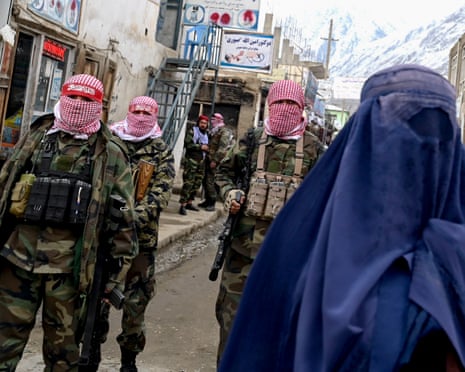 The UN described Taliban-run Afghanistan as a ‘human rights graveyard’. Photograph: Wakil Kohsar/AFP/Getty Images
theguardian.com
The UN described Taliban-run Afghanistan as a ‘human rights graveyard’. Photograph: Wakil Kohsar/AFP/Getty Images
theguardian.com
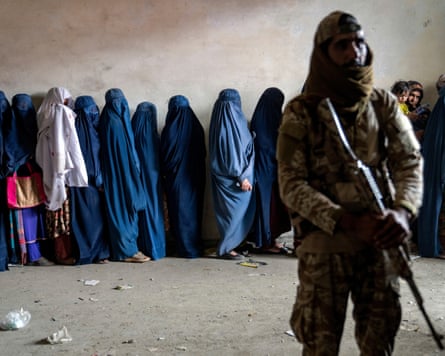 A Taliban fighter stands guard as women wait to receive food rations distributed by a humanitarian aid group in Kabul. Photograph: Ebrahim Noroozi/AP
theguardian.com
A Taliban fighter stands guard as women wait to receive food rations distributed by a humanitarian aid group in Kabul. Photograph: Ebrahim Noroozi/AP
theguardian.com
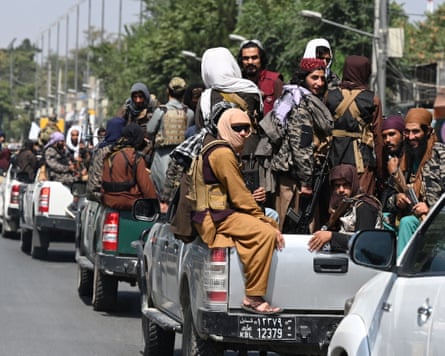 A convoy of Taliban fighters in the days after the fall of Kabul in 2021. Photograph: Aamir Qureshi/AFP/Getty Images
theguardian.com
A convoy of Taliban fighters in the days after the fall of Kabul in 2021. Photograph: Aamir Qureshi/AFP/Getty Images
theguardian.com
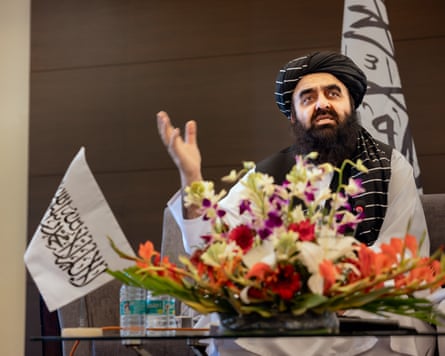 Afghanistan’s foreign minister Mawlawi Amir Khan Muttaqi was criticised for not allowing female journalists into his press conference while visiting India. Photograph: Elke Scholiers/Getty Images
theguardian.com
Afghanistan’s foreign minister Mawlawi Amir Khan Muttaqi was criticised for not allowing female journalists into his press conference while visiting India. Photograph: Elke Scholiers/Getty Images
theguardian.com
Five years after the Taliban returned to Kabul in 2021, more governments are reopening channels to the Islamic Emirate even as UN reports describe expanding bans on women’s education and employment. The Guardian reports that India, Qatar, China, Iran and several Central Asian states have recently hosted Taliban officials or widened contacts, while Russia recognised the Taliban government just over a year ago and signed a military cooperation agreement last month.
The shift is less a thaw than a series of bilateral transactions, each with its own narrow objective. Campaigners quoted by the Guardian warn that piecemeal engagement weakens the only leverage outside powers still claim to have: the promise of diplomatic normalisation in exchange for changes on women’s rights and broader civil liberties. The Taliban, analysts say, treat any meeting as a legitimacy dividend; even “technical” talks can be repackaged at home as proof that the world is adjusting to their rule. The European Union’s June 2024 discussions in Brussels, described by the European Commission as focused on returns of failed asylum seekers, were presented by a Taliban spokesperson as “historic” and a step toward regularised relations.
The incentives are visible in the list of interlocutors. Neighbouring and regional states face cross-border security concerns and want predictable counterparts in Kabul, regardless of how the regime governs. European governments, under pressure to reduce irregular migration, have their own reason to keep lines open: returns require paperwork, coordination and some form of recognition that an authority exists to receive people. In practice, that means human-rights demands compete with administrative needs, and the administrative needs tend to arrive with deadlines.
Inside Afghanistan, the Guardian notes, the domestic trajectory continues in the opposite direction. The United Nations has catalogued edicts barring women from universities and most employment, alongside strict dress codes and the continued exclusion of teenage girls from education. Minorities have faced persecution, and activists and journalists repression, with the UN describing the country as a “graveyard for human rights” in 2024. Human Rights Watch researcher Fereshta Abbasi argues that engagement may be necessary to mitigate the humanitarian crisis, but says contacts without clear conditions risk becoming a one-way concession.
In Kabul, a Taliban fighter stood guard as women waited to receive food rations from a humanitarian aid group. Abroad, the same movement is collecting handshakes and meeting photos, one “technical” visit at a time.