
Strong earthquake hits eastern Indonesia
BMKG issues tsunami warning after 7.7-magnitude quake near Flores, small waves detected as residents flee damaged buildings
Images
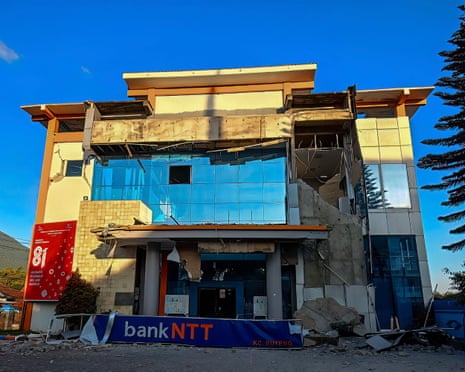 A damaged building after the earthquake in East Nusa Tenggara, on 15 August, 2026. Photograph: SELO/AFP/Getty Images
theguardian.com
A damaged building after the earthquake in East Nusa Tenggara, on 15 August, 2026. Photograph: SELO/AFP/Getty Images
theguardian.com
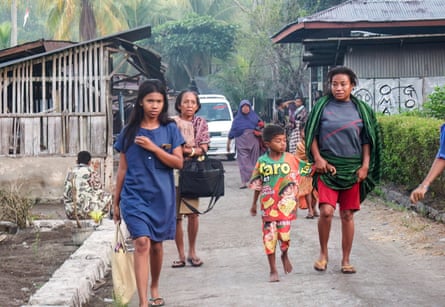 People flee their homes to seek safety following a earthquake in Talibura Village, Sikka, East Nusa Tenggara on 15 August, 2026. Photograph: Arnold Welianto/AFP/Getty Images
theguardian.com
People flee their homes to seek safety following a earthquake in Talibura Village, Sikka, East Nusa Tenggara on 15 August, 2026. Photograph: Arnold Welianto/AFP/Getty Images
theguardian.com
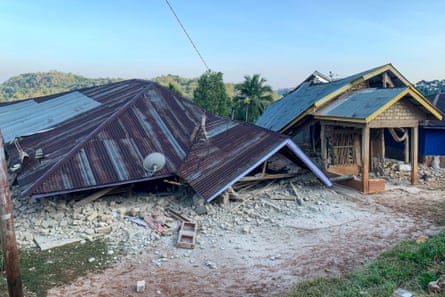 Damaged houses are seen following a 7.7-magnitude earthquake in Ruteng, Manggarai, East Nusa Tenggara, on 15 August, 2026. Photograph: SELO/AFP/Getty Images
theguardian.com
Damaged houses are seen following a 7.7-magnitude earthquake in Ruteng, Manggarai, East Nusa Tenggara, on 15 August, 2026. Photograph: SELO/AFP/Getty Images
theguardian.com
A 7.7-magnitude earthquake struck eastern Indonesia early Saturday, jolting the Flores region and prompting Indonesia’s meteorology, climatology and geophysics agency (BMKG) to issue a tsunami warning. According to The Guardian, the quake hit at 5:58am local time at a shallow depth, and damaged buildings in East Nusa Tenggara province, sending residents and even hospital patients fleeing outside. Two aftershocks followed, including one measured at magnitude 6.1. No immediate casualties were reported in the first hours after the quake.
BMKG warned residents to stay away from beaches and riverbanks as its tsunami modelling suggested waves could be generated across multiple provinces, including East Nusa Tenggara, South Sulawesi, and West Nusa Tenggara. In Maumere, people evacuated to higher ground, and observers reported the sea receding—a sign that can precede a tsunami. Authorities later detected small tsunami waves, measured in the tens of centimeters, after the initial alert.
Indonesia’s repeated cycle—major quake, rushed evacuation, then a narrowing warning—reflects the country’s geography as much as its governance. The archipelago sits on the Pacific Basin’s Ring of Fire, where shallow earthquakes can turn quickly into coastal emergencies, and where the difference between a false alarm and a mass-casualty event may be minutes of warning time and the public’s willingness to move. The practical burden falls on local officials and ordinary households: evacuations disrupt hospitals, markets and transport, while the costs of preparedness are borne continuously even when the worst-case scenario does not materialize.
The quake also illustrates how risk is distributed unevenly across the region. Australia’s tsunami warning centre said there was no tsunami threat to the Australian mainland, islands or territories, underscoring that the same seismic event can be existential for one coastline and largely a monitoring exercise for another. Within Indonesia, coastal communities face the most immediate exposure, while inland areas become temporary refuges—if roads, communications and public buildings remain usable after shaking and aftershocks.
Photographs from East Nusa Tenggara showed damaged buildings and people fleeing homes in Talibura Village in Sikka. As aftershocks continued, BMKG’s warning told people to avoid the shoreline while officials measured what the sea actually did.