
Andy Beckett says UK weather forecasts become culture-war terrain
Met Office heat language meets partisan framing and split regional summers, the old national small talk breaks on the same day’s map
Images
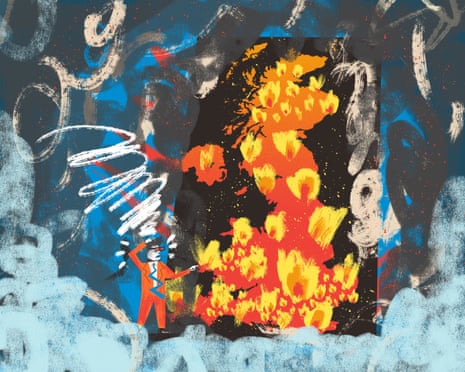 Illustration: Nate Kitch/The Guardian
theguardian.com
Illustration: Nate Kitch/The Guardian
theguardian.com
 Andy Beckett
theguardian.com
Andy Beckett
theguardian.com
Andy Beckett argues UK weather forecasts became a culture-war battleground, Met Office warnings and GB News framing collide as heat and drought intensify, forecasters end up selling both holiday cheer and apocalypse in the same segment
British television’s first regular weather forecaster, George Cowling, opened on the BBC in January 1954 with a line that doubled as practical advice and national small talk: it would be “rather windy”, but still “a good day to hang out the washing”. According to a Guardian column by Andy Beckett, that compact bargain—useful information delivered in a shared, almost apolitical language—has frayed as extreme heat and climate messaging collide with Britain’s media incentives.
Beckett describes a landscape where the same sunshine can be framed as liberation or menace, and where presenters are pushed into tonal whiplash: tanned broadcasters in summer attire celebrating record warmth, then sombre warnings about health risks and infrastructure strain. The column points to geographic divergence inside the UK as a practical driver of this confusion: in the year discussed, western Scotland is described as unusually wet while southern England is portrayed as “desert-like”, weakening the old assumption that the country experiences broadly the same northern European weather at the same time. When the public’s lived experience splits, the shared script that once made forecasts a national meeting point becomes harder to sustain.
On the political-media side, Beckett cites a GB News website headline from a Monday before publication: “Met Office considers issuing red ‘extreme heat warning’ across Britain while nation enjoys ‘incredible summer’.” The construction turns a technical decision—how to classify risk—into an argument about mood, as if warning itself is an attempt to spoil enjoyment. Beckett’s broader claim is that forecasters now have to choose words that will be replayed as cultural signals: too upbeat and they are accused of downplaying danger; too stark and they are accused of preaching or panic.
The column leans on academic work to show the drift. A 2025 paper, “British Heatwave Discourse (1985–2023): from Ice Cream to Armageddon?”, by Thijs van Dooremalen and Philip Smith, analysed national press coverage and found that until 2000 positive and negative portrayals coexisted in roughly equal measure, sometimes in the same newspaper. From 2000 to 2014, coverage moved gradually towards the negative as climate concerns became mainstream. From 2015 onward, the paper finds an “apocalyptic genre” becoming dominant, while a “romantic genre” of celebratory heatwave coverage persists.
Beckett’s point is not that one genre is correct and the other false, but that Britain’s institutions have ended up trying to speak to audiences who want different things from the same forecast: reassurance, entertainment, moral clarity, or a fight. The weather segment, once a low-stakes public service, is increasingly treated as a stage where broadcasters and politicians can win attention without having to own the costs of adaptation.
Cowling’s original promise was simple: tomorrow’s wind, and whether the washing would dry. Seventy-two years later, the argument in Beckett’s column is that Britain still wants the forecast to be small talk even as it becomes a running dispute about what counts as a warning.