
Passenger train derails near Lewes
Two seriously injured and three carriages topple with around 150 onboard, rail investigators arrive as routes close and buses replace timetables
Images
 The train derailed between Haywards Heath and Lewes. Photograph: Marcin Nowak/LNP
theguardian.com
The train derailed between Haywards Heath and Lewes. Photograph: Marcin Nowak/LNP
theguardian.com
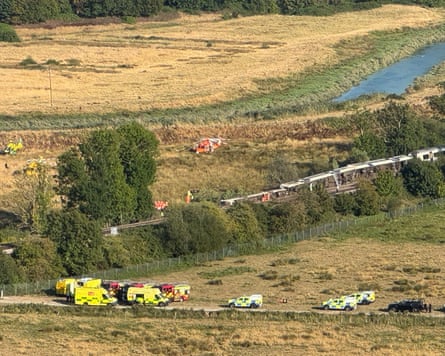 Emergency services respond to the derailed train between Haywards Heath and Lewes. Photograph: PA
theguardian.com
Emergency services respond to the derailed train between Haywards Heath and Lewes. Photograph: PA
theguardian.com
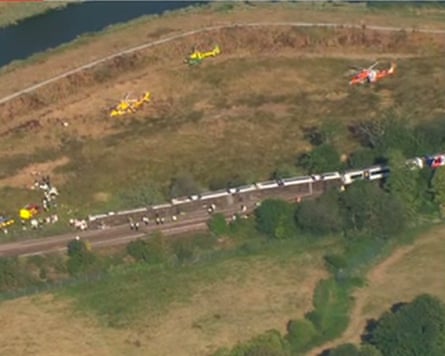 An aerial photograph of the derailment site. Photograph: BBC News
theguardian.com
An aerial photograph of the derailment site. Photograph: BBC News
theguardian.com
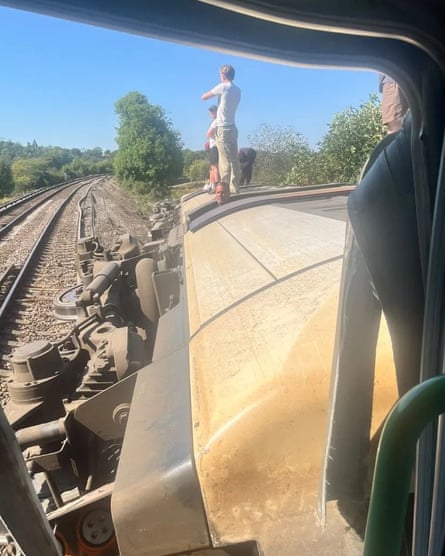 Images of the aftermath appear to show passengers standing on top of the toppled carriages. Photograph: @Defianc_e/Jeremy Veitch
theguardian.com
Images of the aftermath appear to show passengers standing on top of the toppled carriages. Photograph: @Defianc_e/Jeremy Veitch
theguardian.com
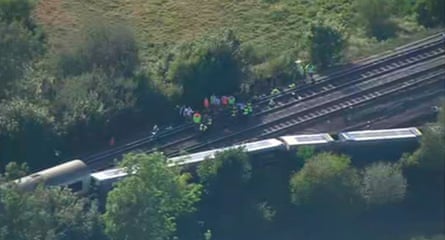 The derailed train near Lewes. Photograph: BBC News
theguardian.com
The derailed train near Lewes. Photograph: BBC News
theguardian.com
 standard.co.uk
 standard.co.uk
 standard.co.uk
Two people were seriously injured after a Southern Rail passenger train derailed near Lewes in East Sussex with around 150 people on board, British Transport Police said. Three carriages ended up on their side and officers declared a major incident, while the Rail Accident Investigation Branch opened an inquiry, according to the Guardian and the Press Association.
The derailment shut routes through the area and forced an improvised evacuation onto nearby heathland as emergency services worked along roads beside the line. Police said nine other passengers suffered less serious injuries, with some taken to hospital and others moved to a local community centre for support. Witness accounts described a sudden sequence of jolts and rocking before the train stopped, with at least one carriage remaining upright while others toppled.
For passengers, the immediate problem was not only the impact but the logistics that follow any rail disruption: access roads, replacement buses, and the slow work of clearing a blocked line. Southern Rail advised travellers to check for updates and warned of long delays, including for journeys to Gatwick Airport, while Network Rail and the operator confirmed the derailed service had been running from London Victoria to Eastbourne.
The official response now moves from rescue to attribution. Transport Secretary Heidi Alexander said she was “deeply concerned” and thanked emergency services, while police said they were supporting investigators as they establish what happened. RAIB inquiries typically focus on immediate technical causes, but the political and commercial consequences tend to fall elsewhere: passengers lose time, operators pay compensation, and maintenance decisions are examined only after a high-profile failure.
An aerial image showed three of the train’s eight carriages lying on their side. By the time officials said everyone was safely off the train, the line itself remained closed, and commuters were being told to plan their journeys around a single event on a stretch of track outside Lewes.