
Trump wealth grows during second term
Guardian details crypto revenues and Truth Social access scheme, Justice Department negotiates IRS settlement shielding family from audits
Images
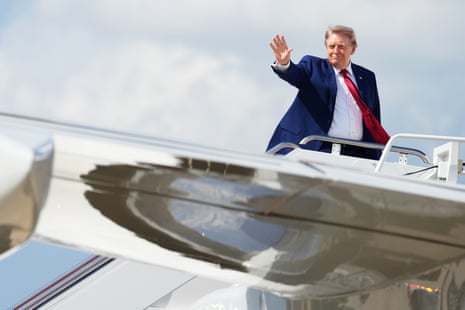 President Donald Trump waves as he boards Air Force One for departure on August 07, 2026 at Joint Base Andrews, Maryland. President Trump is spending the weekend in Bedminster, New Jersey. (Photo by Eric Lee/Getty Images) Photograph: Eric Lee/Getty Images
theguardian.com
President Donald Trump waves as he boards Air Force One for departure on August 07, 2026 at Joint Base Andrews, Maryland. President Trump is spending the weekend in Bedminster, New Jersey. (Photo by Eric Lee/Getty Images) Photograph: Eric Lee/Getty Images
theguardian.com
Donald Trump’s second presidency is generating revenue on a scale that has become a political story in its own right. The Guardian reports that Trump took in $2.2 billion in revenues in 2025, alongside large cryptocurrency holdings and an expanding web of business activity tied to his public role.
The reporting describes a presidency where the usual frictions—audits, internal restrictions, and the fear of investigations—appear weaker than in previous administrations. Trump’s financial disclosure forms, filed in June 2025, showed at least $1.4 billion in crypto-related earnings in 2024, according to the Guardian. The same ecosystem has produced retail losses: the paper cites estimates that roughly one million investors in a Trump crypto scheme lost about $3.8 billion as values swung. In summer 2026, Trump’s Truth Social business promoted a plan offering wealthy buyers early access to his posts for $100,000 a month, a product that turns presidential communications into a paid tier.
The second-order effects are less about one business line than about how institutions respond when the president’s private incentives are made explicit. Senator Mark Warner wrote in July to major Wall Street financial trade groups urging them to reject a Truth Social product called Truth API, arguing that privileged access to potentially market-moving presidential communications should not be normalised, the Guardian reports. The pressure point is reputational: trade groups cannot regulate the president, but they can choose whether to bless the product by integrating it into mainstream finance.
At the same time, the executive branch is implicated in disputes that touch directly on Trump’s personal finances. The Guardian says Trump’s Justice Department was involved in negotiating a settlement of a lawsuit Trump brought against the IRS over a leak of his tax returns. The reported deal would grant Trump and his family immunity from IRS audits of prior returns and could save him about $100 million. The mechanism is bureaucratic rather than dramatic: benefits are delivered through legal settlements and administrative protections that are hard to unwind once signed.
Foreign money appears repeatedly in the account. The Guardian reports that Trump accepted a $400 million plane as a gift from Qatar, raising questions among analysts about whether the arrangement sidesteps the constitutional prohibition on foreign emoluments. The same pattern—foreign interests paying for proximity, access, or business—extends to overseas hotel and golf deals involving the Trump family.
A late-July CNN poll cited by the Guardian found 66% of respondents saying Trump does not put the good of the country over his personal gain. The more concrete measure is that the presidency now contains a subscription plan for early access to the president’s posts, priced at $100,000 per month.