
Arwa Mahdawi: US State Department grants fund European conservative think tanks
USAID cuts sold as America first while overseas political spending shifts channels, civilizational messaging gets the line item
Images
 Donald Trump speaking at Wheeler High School in Marietta, Georgia, 22 July 2026. Photograph: Saul Loeb/AFP/Getty Images
theguardian.com
Donald Trump speaking at Wheeler High School in Marietta, Georgia, 22 July 2026. Photograph: Saul Loeb/AFP/Getty Images
theguardian.com
 Arwa Mahdawi
theguardian.com
Arwa Mahdawi
theguardian.com
 Photograph: Guardian
theguardian.com
Photograph: Guardian
theguardian.com
Arwa Mahdawi writes in the Guardian that while Donald Trump and allied media spent months portraying the US Agency for International Development as a symbol of waste, the machinery of US overseas political spending has continued—only with different beneficiaries.
The column points to a February 2025 Truth Social post in which Trump called USAID corruption “rarely seen before” and urged supporters to “CLOSE IT DOWN!” Mahdawi says that within hours USAID was effectively shuttered, with most staff placed on indefinite administrative leave, and humanitarian aid later cut under the banner of “America first”. Rightwing outlets amplified the message with claims such as Fox News’s repeated allegation that USAID was buying “millions” of condoms for Gaza—an accusation the piece describes as a lie unsupported by evidence.
Yet, according to Mahdawi, money did not stop flowing abroad. Instead, the column describes a new pattern: US State Department grantmaking that appears to steer taxpayer funds toward conservative organisations in Europe aligned with Trump’s political project. The Guardian reports that the State Department intends to grant $12 million to conservative organisations in the UK, with $7 million earmarked for a group called 878, which Mahdawi says was co-founded by former Conservative minister and television host Jacob Rees-Mogg. The group was incorporated in the UK in March, and its website describes it as a “leading British and American thinktank” focused on strengthening a “civilisational partnership” between the UK and the US.
Mahdawi cites a former US official who says normal funding processes are being “subverted” so money can reach Trump-aligned causes. Other grant calls, the piece says, invite European groups to build “civilizational self-confidence” and work on themes including national sovereignty, migration, censorship and “lawfare”—a vocabulary that mirrors the messaging of many transatlantic conservative networks. Zsuzsanna Végh, a researcher focused on liberal democracy, tells the Guardian that such calls follow a long period of networking among Maga and like-minded European actors who have identified likely recipients.
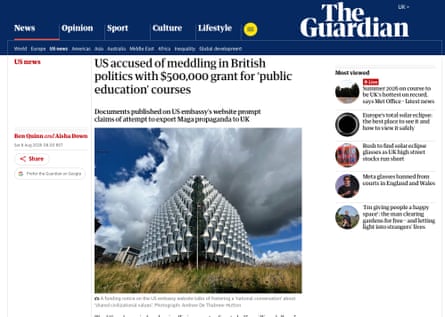
The column also describes political pushback. German chancellor Friedrich Merz has warned Trump’s administration against interfering in German elections, Mahdawi writes, and in the UK Liberal Democrat MP Lisa Smart has accused “Maga money” of meddling in British democracy. The US embassy in London, according to the piece, is offering grants of up to $500,000 for “public education” programmes intended to foster a “national conversation” about “shared civilizational values” between the UK and US; a recently departed State Department official tells the Guardian this resembles an attempt to create UK-originated narratives that can be recycled in Maga-aligned propaganda.
Mahdawi’s snapshot of the post-USAID landscape leaves a concrete contrast: humanitarian programmes were cut in the name of keeping money at home, while State Department grant notices still advertise large sums for political “civilizational” messaging abroad.